Project Type: EXHIBITION

PAUL SCOTT in: Absence Takes Form: The 2026 NCECA Annual

PAUL SCOTT in: Absence Takes Form: The 2026 NCECA Annual

Paul Scott in

ABSENCE TAKES FORM: The 2026 NCECA ANNUAL

Curated By Adrienne Spinozzi.

WASSERMAN PROJECTS
3434 Russell Street, #502, Detroit, MI
Located on the north side of the building at the end of the gravel driveway off Russell Street. Enter through red door.

January 31st through April 4th, 2026

OPEN HOURS

Wednesday 10am–6pm
Thursday–Saturday 12-6pm (Friday open until 9pm)

RECEPTION:

Friday, March 27th | 6–9pm

ABOUT THE EXHIBITION


ABSENCE TAKES FORM: The 2026 NCECA ANNUAL

Curated By Adrienne Spinozzi.

In partnership with the National Council on Education for Ceramic Arts (NCECA), Wasserman Projects is proud to present Absence Takes Form. Curator Adrienne Spinozzi, Associate Curator in the American Wing at the Metropolitan Museum writes:

“Absence Takes Form explores how artists express their individual diasporic journeys in clay, taking its inspiration from Detroit, a place with a rich history shaped by the Great Migration. All diaspora and migrations are complex negotiations between gain and loss, defined by displacement, memory, and promise. These formative life experiences can offer fertile inspiration to artists, and the works in this exhibition give voice and physical space to ancestral memories by turning absence into a three-dimensional form. This reparative work is expressed in myriad ways, including acknowledging a life lived, embracing visual signifiers of one’s identity, honoring and preserving cultural techniques and traditions, and engaging in a conceptual practice that reconstructs the past anew. In this exhibition, artists engage in the act of processing their memory of an ancestral homeland through creation. Absence takes form.”

NCECA Annual blends impactful attributes of invitational and open-juried models of exhibition development. Exhibition curator Adrienne Spinozzi’s curatorial vision is illuminated through the work of five invited artists. Additional works and artists will be selected through an open call for submissions.

INVITED ARTISTS

Adebunmi Gbadebo
David R. MacDonald
Anina Major
Ibrahim Said
Yeesookyung

JURIED ARTISTS

Ivan Albreht, Natalia Arbelaez, Lisa Marie Barber, Malene Djenaba Barnett, Ron Baron, Yael Braha, Pattie Chalmers, Jonathan Christensen Caballero, Kaneez Zehra Hassan, Hongmi Kim Hoog, Quinn Alexandria Hunter, Roxanne Jackson, Tim Keenan, Wansoo Kim, Robert King, Josephine Larsen, Jae Won Lee, Kimberly LaVonne, Mahalexmi Mohan, Steven Montgomery, Janet Neuwalder, Joy Okokon, Ross Junior Owusu, Kyungmin Park, Yana Payusova, Tia Santana, Paul Scott, Stephanie Shih, Ellie Stanislav, Silvia Tagusagawa, Hirotsune Tashima, Iren Tete, Kwok-Pong (Bobby) Tso, Karina Yanes, Ari Zuaro

ABOUT THE CURATOR

Adrienne Spinozzi is an Associate Curator in the American Wing at the Metropolitan Museum of Art, where she is responsible for the American redware, stoneware, and art pottery collections. Her recent projects include Shapes from Out of Nowhere: Ceramics from the Robert A. Ellison Jr. Collection (2021), an exhibition of 20th- and 21st-century abstract and nonrepresentational ceramics, and Hear Me Now: The Black Potters of Old Edgefield, South Carolina (2022-24), an exhibition on the contributions of the enslaved potters—both known and unknown—in western South Carolina during the 19th century. She is currently working on a reinstallation of American ceramics that will span the late 19th century through today.

FEATURED ARTWORK

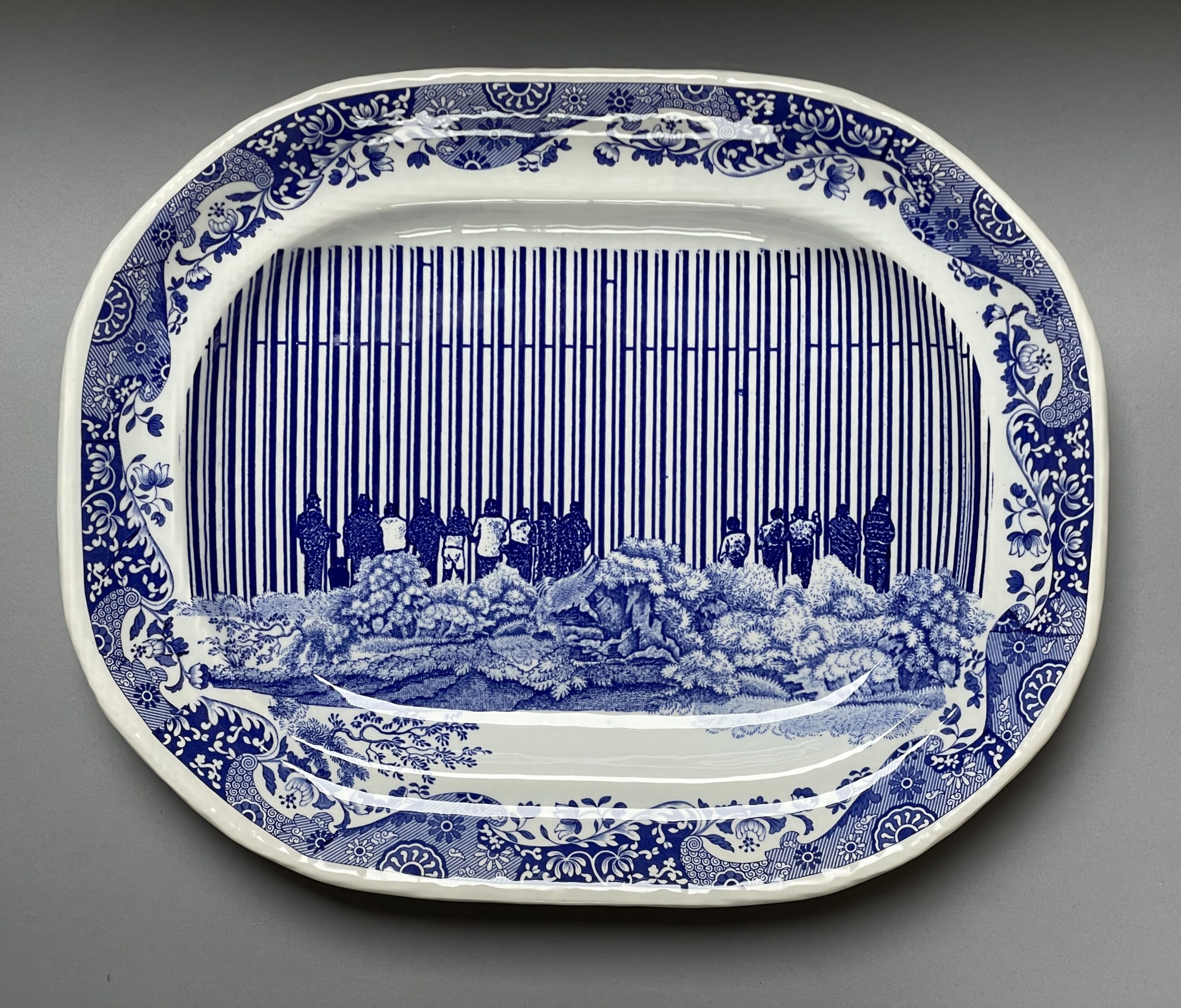
Paul Scott, “Cumbrian Blue(s) New American Scenery, Across the Borderline”, 2021, transfer print collage on pearlware platter (created from a scan of Niagara Falls platter (c1830) by Enoch Wood & Sons), 15.4 x 12.2 x 2″, photo courtesy of the artist.

INSTALLATION PHOTOS

English, b. 1953, Darley Dale, Derbyshire, England
lives and works in Cumbria, UK

Paul Scott is a Cumbrian-based artist with a diverse practice and an international reputation. Creating individual pieces that blur the boundaries between fine art, craft and design, he is well known for research into printed vitreous surfaces, as well as his characteristic blue and white artworks in glazed ceramic.

Scott’s artworks can be found in public collections around the globe – including The National Museum of Art, Architecture and Design Norway, the Victoria and Albert Museum London, National Museums Liverpool, Carnegie Museum of Art, Pittsburgh and Brooklyn Art Museum USA. Commissioned work can be found in a number of UK museums as well as public places in the North of England, including Carlisle, Maryport, Gateshead and Newcastle Upon Tyne. He has also completed large-scale works in Hanoi, Vietnam and Guldagergård public sculpture park in Denmark.

A combination of rigorous research, studio practice, curation, writing and commissioned work ensures that his work is continually developing. It is fundamentally concerned with the re-animation of familiar objects, landscape, pattern and a sense of place. He was Professor of Ceramics at Oslo National Academy of the Arts (KHiO) from 2011–2018. Scott received his Bachelors of Art Education and Design at Saint Martin’s College and Ph.d at the Manchester Institute for Research and Innovation in Art and Design in Manchester, England.

His current research project New American Scenery has been enabled by an Alturas Foundation artist award, Ferrin Contemporary, and funding from Arts Council England. More on New American Scenery, here.
PAUL SCOTT & CAROLINE SLOTTE in: One Way or Another

PAUL SCOTT & CAROLINE SLOTTE in: One Way or Another

HB381

381 Broadway
New York, NY

January 9 – February 28, 2026

ABOUT THE EXHIBITION


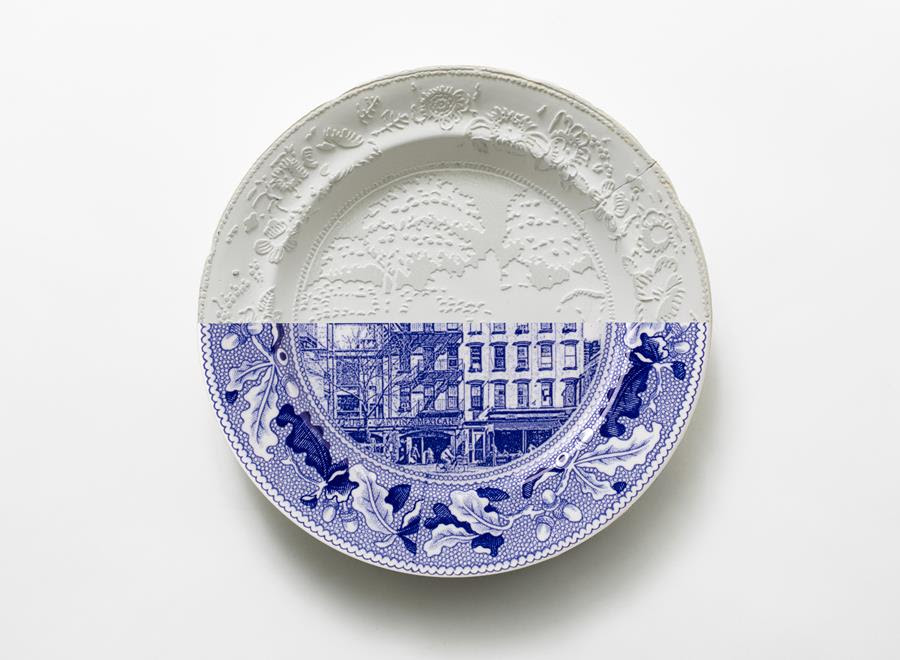
HB381 is pleased to announce One Way or Another, a two-person exhibition of new ceramic works by Paul Scott (b. 1953, United Kingdom) and Caroline Slotte (b. 1975, Finland). Slotte studied ceramics with Scott when he was a professor at the Bergen Academy of Art and Design in the early 2000s and their practices have dovetailed in various ways since. Both artists invoke the storied space of European porcelain and faience wares as a repository of cultural mores and readymade imagery. Collectively, they draw on the history of objects as an apt framework for parsing psychological and political affairs of the present day. While their techniques for altering these historic objects find different expressions, their attention to this space of visual and material culture is equally acute, feeding into discourses on craft and cultural studies and museological concerns around heritage and preservation.

Scott resides in the UK in the county of Cumbria, from where he pulls his moniker and frequent title “Cumbrian Blue(s),” a phrase which is stamped or painted onto the verso of many of his pieces. With a diverse practice and an international reputation, he is known for his blue-and-white ceramics that address current events with a historical through line, blurring the boundaries between fine art, craft, and design. Over time, his practice has become closely tied to his own research into printed vitreous surfaces as he has developed an extraordinary expertise on the intricacies of porcelain and transferware production. The innumerable pieces of vintage pottery that have passed through his hands lent him an intimate awareness of the life of objects and their journeys.

“I habitually collect glazed tableware from eBay, junk and antique shops,” Scott writes. “Some of it has crazed glazing, some may be cracked, chipped, or the gold lustre worn from the edges … over time I have grown very fond of these imperfections. Some are simply beautiful in their own right, as cracks trace a line across a form, or blooms in the glaze create vitreous clouds in the glassy surface.” In part, it is the care shown for humble objects in connection with his astute political commentary which makes Scott’s work feel so arresting and truthful. His approach is fundamentally concerned with the reanimation of familiar objects, landscape, pattern, and a sense of place. Works from his New American Scenery series like Toll and Residual Waste (Texas) update the picturesque tradition of landscape with scenes of smokestacks, semi-trucks, and toll roads, turning attention to our asphalt and blacktop-tinged treatment of the land. Cloud Studies (after Thomas Cole & Eadweard Muybridge) inserts the profile of a passenger airplane overtop the billowing outlines of drifting clouds, referencing two image makers who helped to define the aesthetic of the U.S. American landscape.

Meanwhile, Slotte brings a more minimalist approach to the treatment of antique plates and china tableware, subtracting matter to render intricate, sandblasted lines and ghostly tracings. Her delicate yet densely-layered patterns interrupt the material coherence of these common objects, revealing moments of absence, ambiguity, and blankness. These acts of redaction, which design historian Glenn Adamson refers to as “a strange sort of craft, consisting as it does almost entirely in deletion,” underscore the curious nature of mass-produced decorative objects; by taking away layers of glaze and clay, Slotte draws our attention to their stylized forms and materiality. Each of her scenes, as though sculpted by erosion, becomes a uniquely altered variation on the theme. In doing so, her artworks broaden our attention to address questions of cultural association, material memory, and the inevitable losses and transformations of time.

“On one level, these works speak to the partial and elusive nature of collective memory,” Adamson writes, “which might be defined as that which is left behind, when all else is forgotten. Yet Slotte’s painstaking act of erasure can also be read as deeply personal. The title Going Blank Again is a short story in three words, which strikes right to the heart of anyone who’s ever been at a loss. And who hasn’t?”

Slotte’s lyrical interventions into the surfaces of blue-and-white transferware mark her subjects through acts of selection and deletion. Vaporous landscapes, clarified from the now classical scenes of the porcelain tradition, emerge out of porous accumulations of pixel-like spheres akin to halftone dots. The Blue Willow and Wild Rose patterns are prominent, but there are others like J. Jamieson & Co.’s Bosphorus Blue, depicting attenuated minarets lining the Bosphorus Strait, and numerous scenes that evoke far-flung travel vistas and locales. Slotte’s alterations to the originals unsettle and transform their mass-produced subjects, changing our experience of longing and wanderlust into something more reflective, opaque, and uncertain.

The instability of these images operates like a secondhand memory: the familiar pattern so often repeated becomes beautifully and thoughtfully transmuted into something unfamiliar. Rippling azure spheres of sky crossed by wispy clouds ricochet across the surfaces of plates and platters in her American Skies series. The artist’s technique enacts something akin to a disappearing act; by carefully masking the surface of each plate, then sandblasting what remains, she effaces certain details while bringing others to the fore. Under her hand, enigmatic forms are scoured into the clay body underlying historic plates and platters, calling our attention back to the physical matter of ceramics and glaze: its permeable and rough textures, its opalescent gloss and vitreous liquidity, the light staining and appearance of imperfect yet entirely natural marks of age, use, and individuality.

As Adamson asserts, “Together, [Scott and Slotte] show how art can open up an apparently inconsequential domain of material culture, showing it to be far more expansive than one could have imagined.” Indeed, the carefully-cropped and edited views of city, sky, and countryside featured in the two artists’ work are capacious and unexpected, revealing a commentary on landscape that is at once incisive, fragmented, and hypnotic.

One Way or Another is presented in collaboration with Ferrin Contemporary.

INSTALLATION PHOTOS

WORKS BY PAUL SCOTT

WORKS BY CAROLINE SLOTTE

EXHIBITION CATALOG & MEDIA


PAUL SCOTT & CAROLINE SLOTTE: One Way or Another

With essay by Glenn Adamson
January 2026

Paul Scott & Caroline Slotte: One Way or Another is a catalogue published by Hostler Burrows on the occasion of the artists’ exhibition at HB381.

Softcover (embossed, matte finish)
48 pages
10″ x 8″
January 2026

With an essay by Glenn Adamson
Photography by Chikako Harada, Caroline Slotte, Øystein Klakegg (p.4),
Joakim Bergström (p.10), John Polak, & Paul Scott
Catalogue Design by LevievanderMeer, Amsterdam
Printing by robstolk®, Amsterdam

PURCHASE AND LEARN MORE

Caroline Slotte Artist Talk

Watch the artist Talk in context of the exhibition “One Way or Another” at HB381 with artist Caroline Slotte and co-curators Juliet Burrows and Leslie Ferrin.

WATCH ON VIMEO

PROGRAMMING


OPENING RECEPTION

January 9th, 2026
6-8pm EST

Join HB381 for the opening of One Way or Another featuring Paul Scott and Caroline Slotte. This event is free and open to the public.

The American Ceramic Circle Presents:

ARTIST TALK with Caroline Slotte featured in “One Way or Another” at HB381

January 22nd, 1pm to 2:30pm EST

HB381
381 Broadway
New York, NY 10013

Overview

ACC members Juliet Burrows and Leslie Ferrin welcome the American Ceramics Circle and guests to a talk & reception with artist Caroline Slotte

Artist Caroline Slotte and co-curators Juliet Burrows and Leslie Ferrin invite members of the American Ceramics Circle and guests for a talk & reception at HB381 Gallery on Thursday, January 22 from 1:00-2:30 PM, in context of the exhibition One Way or Another.

PRESS


Paul Scott on Yale University Radio

Brainard Carey Interviews Paul Scott for Yale University Radio

WYBC, Yale University, January 23, 2026

LISTEN HERE

ABOUT THE ARTISTS


English, b. 1953, Darley Dale, Derbyshire, England
lives and works in Cumbria, UK

Paul Scott is a Cumbrian-based artist with a diverse practice and an international reputation. Creating individual pieces that blur the boundaries between fine art, craft and design, he is well known for research into printed vitreous surfaces, as well as his characteristic blue and white artworks in glazed ceramic.

Scott’s artworks can be found in public collections around the globe – including The National Museum of Art, Architecture and Design Norway, the Victoria and Albert Museum London, National Museums Liverpool, Carnegie Museum of Art, Pittsburgh and Brooklyn Art Museum USA. Commissioned work can be found in a number of UK museums as well as public places in the North of England, including Carlisle, Maryport, Gateshead and Newcastle Upon Tyne. He has also completed large-scale works in Hanoi, Vietnam and Guldagergård public sculpture park in Denmark.

A combination of rigorous research, studio practice, curation, writing and commissioned work ensures that his work is continually developing. It is fundamentally concerned with the re-animation of familiar objects, landscape, pattern and a sense of place. He was Professor of Ceramics at Oslo National Academy of the Arts (KHiO) from 2011–2018. Scott received his Bachelors of Art Education and Design at Saint Martin’s College and Ph.d at the Manchester Institute for Research and Innovation in Art and Design in Manchester, England.

His current research project New American Scenery has been enabled by an Alturas Foundation artist award, Ferrin Contemporary, and funding from Arts Council England. More on New American Scenery, here.

b. 1975 Helsinki, Finland
lives and works in Helsinki, Finland

Caroline Slotte holds an MA in Ceramics from Bergen Academy of Art and Design, Norway, in addition to education from Denmark and Finland. From 2007 to 2011 Slotte was a research fellow in the Norwegian Artistic Research Fellowship Programme. Affiliated with Bergen Academy of Art and Design, Dept of Specialised Art, she was also a member of the interdisciplinary research project Creating Art Value, funded by the Research Council of Norway.

The reworking of second hand objects play a pivotal role in Caroline Slotte´s practice. She manipulates found materials, primarily ceramic everyday items, so that they take on new meanings. The tensions between the recognizable and the enigmatic, the ordinary and the unexpected are recurring thematic concerns. More recent explorations reveal an expanded interest in material perception and material recognition, teasing out situations where the initial visual identification fails resulting in an unsettling state of material confusion. Demonstrating an engaged sensitivity towards the associations, memories and narratives inherent in the objects, Slotte´s intricate physical interventions allows us to see things we would otherwise not have seen.

Slotte´s works have been exhibited internationally and acquired by, among others, the Museum of Arts and Design in New York, the Victoria & Albert Museum in London, Röhsska Museum in Gothenburg, the Design Museum in Helsinki and the Museum of Decorative Arts in Oslo.

Jacqueline Bishop: Sojourner Truth | Ain’t I a Lady

Jacqueline Bishop: Sojourner Truth | Ain’t I a Lady

Ain’t I A Lady
2025
embroidered silk

SOJOURNER TRUTH | AIN’T I A LADY

ABOUT Ain’t I A Lady


More on Jacqueline Bishop HERE

Sojourner Truth | Ain’t I a Lady… is a riff on the most famous statement considered with Sojourner Truth –  “Ain’t I a Woman”. The dress is made of silk based on an iconic photograph of Sojourner Truth. The dress and scarves were sewn in Jamaica, with hand embroidery by women involved with Project Threadways in Alabama.

On view in Archives in Practice, Center for Craft, Asheville, NC

Sojourner Truth Ain’t I A Lady
2025, Silk

While researching the history of silk-making on South Carolina plantations by enslaved individuals, Jacqueline Bishop came to realize that American abolitionist and civil rights activist Sojourner Truth wove silk in Northampton, Massachusetts. Sojourner Truth Ain’t I A Lady visually represents her findings. To create this piece, she collaborated with Project Threadways, an organization dedicated to documenting, studying, and interpreting history, community, and power through the lens of fashion and textiles. Together, they embroidered flowers from Truth’s parents’ homelands in Guinea and Ghana, as well as native New York flowers, onto a scarf that accompanies a dress inspired by a photograph of Truth.

The title is inspired by Sojourner Truth’s speech “Ain’t I a Woman?” at the 1851 Women’s Rights Convention in Akron. This research was supported by the Center for Craft’s 2024 Craft Research Fund.

On loan from Ferrin Contemporary


RECENTLY ON VIEW

Archives in Practice


At the Center for Craft | Asheville, NC | September 12, 2025 – February 17, 2026

AVAILABLE TO TOUR

If you’d like to show Jacqueline Bishop’s “Ain’t I a Lady” at your institution, please fill out this form to begin the process. We look forward to working with you!

JACQUELINE BISHOP in: The River That Flows Both Ways, Bobst Library, NYU

JACQUELINE BISHOP in: The River That Flows Both Ways, Bobst Library, NYU

Bobst Library, New York University

70 Washington Square S
New York, NY

On view permanently starting October 2025

ABOUT THE EXHIBITION


The River That Flows Both Ways showcases a series of compelling and contemplative ceramic works by visual artist Jacqueline Bishop in her pursuit of commemorating the buried, interlinked histories of the Lenape lands on which most of NYU’s New York campus is located.

Featuring archival collage digitally printed on six porcelain plates, The River That Flows Both Ways illuminates the early encounters of African enslaved laborers brought into Indigenous communities by European settlers during the 1600s. These complex interactions and intricate trade routes are juxtaposed with architectural landmarks alongside the flora and fauna native to New York.

The River That Flows Both Ways (The Island of Many Hills)
2025
Pickard China chargers with digital transfers of original collage imagery by Jacqueline Bishop, fabricated by Kala Stein Studio
12″.

MEDIA


NYU-TV

November 25th, 2025

Destinee Fillmore speaks with artist Jacqueline Bishop about her practice and her ceramic work, The River That Flows Both Ways, now a permanent exhibition on NYU Bobst Library’s 10th floor.

PAST PROGRAMMING


Exhibition Opening and Artist Conversation: The River That Flows Both Ways | In-Person

Date: Tuesday, October 14, 2025
Time: 6:00pm – 8:00pm
Time Zone: Eastern Time – US & Canada (change)
Location: Bobst Library, 10th Floor, North Reading Room

Join NYU artist and professor Jacqueline Bishop for the opening of The River That Flows Both Ways at Bobst Library

Join NYU Libraries and the School of Liberal Studies in celebrating the opening of The River That Flows Both Ways, a commissioned installation by artist and professor Jacqueline Bishop. The event will feature a conversation between the artist and Destinee Filmore from The Metropolitan Museum of Art.

Jacqueline Bishop is a Jamaican-born writer, visual artist, scholar, and Clinical Full Professor of Liberal Studies at NYU. Her art renders marginalized voices visible across the African diaspora, and spans mediums including porcelain, collage, painting, and textiles.

Destinee Filmore is a curator, art historian, and cultural preservationist. Her research focuses on expansive histories of the visual and material culture of the United States and broader Atlantic World. She is the founder of On This Land—an interdisciplinary project that identifies, documents, and saves sites of historical importance.

Doors open at 6:00 p.m. and a conversation with the artist will begin at 6:30. This event is co-sponsored by NYU Liberal Studies and NYU Libraries.

This event has now passed.

Jacqueline Bishop is an accomplished writer, academic, and visual artist with exhibitions in Belgium, Morocco, Italy, Cape Verde, Niger, USA, and Jamaica. In addition to her role as Clinical Full Professor at New York University, Jacqueline Bishop was a 2020 Dora Maar/Brown Foundation Fellow in France; 2008-2009 Fulbright Fellow in Morocco; and 2009-2010 UNESCO/Fulbright Fellow in Paris. Bishop has received several awards, including the OCM Bocas Award for her book “The Gymnast & Other Position”, The Canute A. Brodhurst Prize for short story writing, The Arthur Schomburg Award for Excellence in the Humanities from New York University, A James Michener Creative Writing Fellowship, as well as several awards from the Jamaica Cultural Development Commission. Jacqueline’s recent ceramic work consists of brightly colored bone China plates used symbolically in Caribbean homes and explores how they hid the violent legacy of slavery and colonialism in the Atlantic world.

JACQUELINE BISHOP in: Archives in Practice

JACQUELINE BISHOP in: Archives in Practice

Center for Craft

67 Broadway St
Asheville, NC

September 12, 2025 – February 17, 2026

ABOUT THE EXHIBITION


Archives can be a link to the past while reflecting the present. They often take the form of objects, memories, or contemplations from histories.

Archives in Practice features eight artists whose work is influenced by archival research. Drawing from personal, familial, and public collections, cultural heritage, and various reference materials, their work communicates the diversity of what an archive can be and how artists can activate them to retell histories that might otherwise be lost, hidden, or erased. Collectively, these artists illustrate the interconnectedness of the past, the individual, and the present—revealing the importance of connecting to one’s diaspora and community, building representation of histories, and conducting object research.

This exhibition also demonstrates the expansive quality of craft research. The artists’ work embodies themes of identity within historical contexts and through personal explorations. It engages with social issues and prompts important questions about the significance and impact of objects, photographs, and the intangible on everyday material practices.

The featured artists are Jacqueline Bishop, N.E. Brown, Ruth Hallows, Margaret Jacobs, Hùng Lê, Aaron McIntosh, and Ruth Tamura & Helen Lee.

Seven of these artists are alumni of the Center for Craft. Two of the artworks on display—Gisma̱xsa G̱a̱tgyedm Na Sigidmhanaa’na̱gm, Our Matriarchs Endow Our Strength by Ruth Hallows, and Sojourner Truth Ain’t I A Lady by Jacqueline Bishop—are the direct result of research funded by Center for Craft grants and fellowship programs.

ARTISTS
Jacqueline Bishop
N.E. Brown
Ruth Hallows
Margaret Jacobs (Akwesasne Mohawk)
Hùng Lê
Aaron McIntosh
Ruth Tamura
Helen Lee


CURATED BY
Mellanee Goodman

IN CONVERSATION


Produced by the Center of Craft, Jacqueline Bishop and curator Mellanee Goodman discuss Bishop’s work in Archives in Practice. More context about Bishop’s “Ain’t I A Lady” (dress), begins around 7:30 minutes into the video.

Craft Watch: CRF20

Jacqueline Bishop is an accomplished writer, academic, and visual artist with exhibitions in Belgium, Morocco, Italy, Cape Verde, Niger, USA, and Jamaica. In addition to her role as Clinical Full Professor at New York University, Jacqueline Bishop was a 2020 Dora Maar/Brown Foundation Fellow in France; 2008-2009 Fulbright Fellow in Morocco; and 2009-2010 UNESCO/Fulbright Fellow in Paris. Bishop has received several awards, including the OCM Bocas Award for her book “The Gymnast & Other Position”, The Canute A. Brodhurst Prize for short story writing, The Arthur Schomburg Award for Excellence in the Humanities from New York University, A James Michener Creative Writing Fellowship, as well as several awards from the Jamaica Cultural Development Commission. Jacqueline’s recent ceramic work consists of brightly colored bone China plates used symbolically in Caribbean homes and explores how they hid the violent legacy of slavery and colonialism in the Atlantic world.

CRISTINA CÓRDOVA in: Vaivén: 21st-Century Art of Puerto Rico and Its Diaspora

CRISTINA CÓRDOVA in: Vaivén: 21st-Century Art of Puerto Rico and Its Diaspora

September 9 – December 6, 2025

Katherine E. Nash Gallery
405 21st Avenue South Minneapolis, MN 55455
The Katherine E. Nash Gallery is housed with the Regis Center for Art on the University of Minnesota west bank campus.

Featuring work by Cristina Córdova

ABOUT THE EXHIBITION


Derived from Spanish for “back-and-forth movement,” vaivén is most associated with the supposed ease at which Puerto Ricans migrate between the US and Puerto Rico. Beyond the comings and goings of travel, this word invokes something much more profound, naming decades of physical, cultural, and emotional ebb and flow that has resulted in more persons of Puerto Rican descent living across the fifty United States than in Puerto Rico itself. To be “of Puerto Rico” is to be inextricably linked with diaspora, Black and Caribbean epistemologies, and a constant reimagining of home and belonging. In response, Vaivén: 21st-Century Art of Puerto Rico and Its Diaspora gathers forty-three artists whose work bears witness to a quarter century of cultural, political, and migratory oscillations, while challenging dominant cultural narratives of “island” post-disaster resiliency versus “mainland” diasporic neither-here-nor-there identity. By tracing conceptual and aesthetic intersections across a range of approaches to image- and mark-making, sculpture and installation, and sound and video, artists in the exhibition explore the hybridity of memory, language, place, and ancestral knowledge as they relate to acts of witnessing, resistance, and connection. The exhibition and accompanying catalogue document new constellations of artists who challenge geographic and cultural authenticity, racialization, and classism, that have shaped which voices define Puerto Rican contemporary art, and which continue to be devalued.

The exhibition is organized by the Katherine E. Nash Gallery, operated by the Department of Art, in association with Hidrante, San Juan. A fully illustrated bilingual English and Spanish accompanying catalogue includes contributions from Arlene Dávila, Yomaira C. Figueroa-Vásquez, Teréz Iacovino, María Elena Ortiz, José López Serra, Carlos Ortiz Burgos, and Monica Uszerowicz. Vaivén: 21st-Century Art of Puerto Rico and Its Diaspora is made possible by support from The Andy Warhol Foundation for the Visual Arts, the National Endowment for the Arts, the Elizabeth Firestone Graham Foundation, the Harlan Boss Foundation for the Arts, the University of Minnesota Imagine Fund, and Ann and Michael G. Hofkin.

ABOUT CRISTINA CÓRDOVA


Puerto Rican, b. 1976, Boston, MA
lives and works in Penland, NC

Native to Puerto Rico, Cristina Córdova creates figurative compositions that explore the boundary between the materiality of an object and our involuntary dialogues with the self-referential. Images captured through the lens of a Latin American upbringing question socio-cultural notions of gender, race, beauty, and power.  Córdova has received numerous grants including the North Carolina Arts Council Fellowship Grant, a Virginia Groot Foundation Recognition Grant, several International Association of Art Critics of Puerto Rico awards, and a prestigious United States Artist Fellowship award in 2015.

Córdova has had solo exhibitions at the Alfred Ceramic Art Museum, (Alfred, NY), and her work is included in the collections of the Renwick Gallery of the Smithsonian American Art Museum, (Washington, DC), Colección Acosta de San Juan Puerto Rico, (San Juan, PR), the Mint Museum of Craft + Design, (Charlotte, NC), and Museum of Contemporary Art, (San Juan, PR). In 1998, Córdova completed her BA at the University of Puerto Rico, and she received her MFA from the New York State College of Ceramics at Alfred University in 2002. Córdova is represented by Ferrin Contemporary.

BETH LIPMAN: Oncoming Close

BETH LIPMAN: Oncoming Close

BETH LIPMAN: Oncoming Close

Trout Museum
Bank of Kaukauna Wing: Marissa & Ryan Downs Gallery ​
325 E. College Avenue
Appleton , WI

October 11, 2025 – January 4, 2026

ABOUT THE EXHIBITION


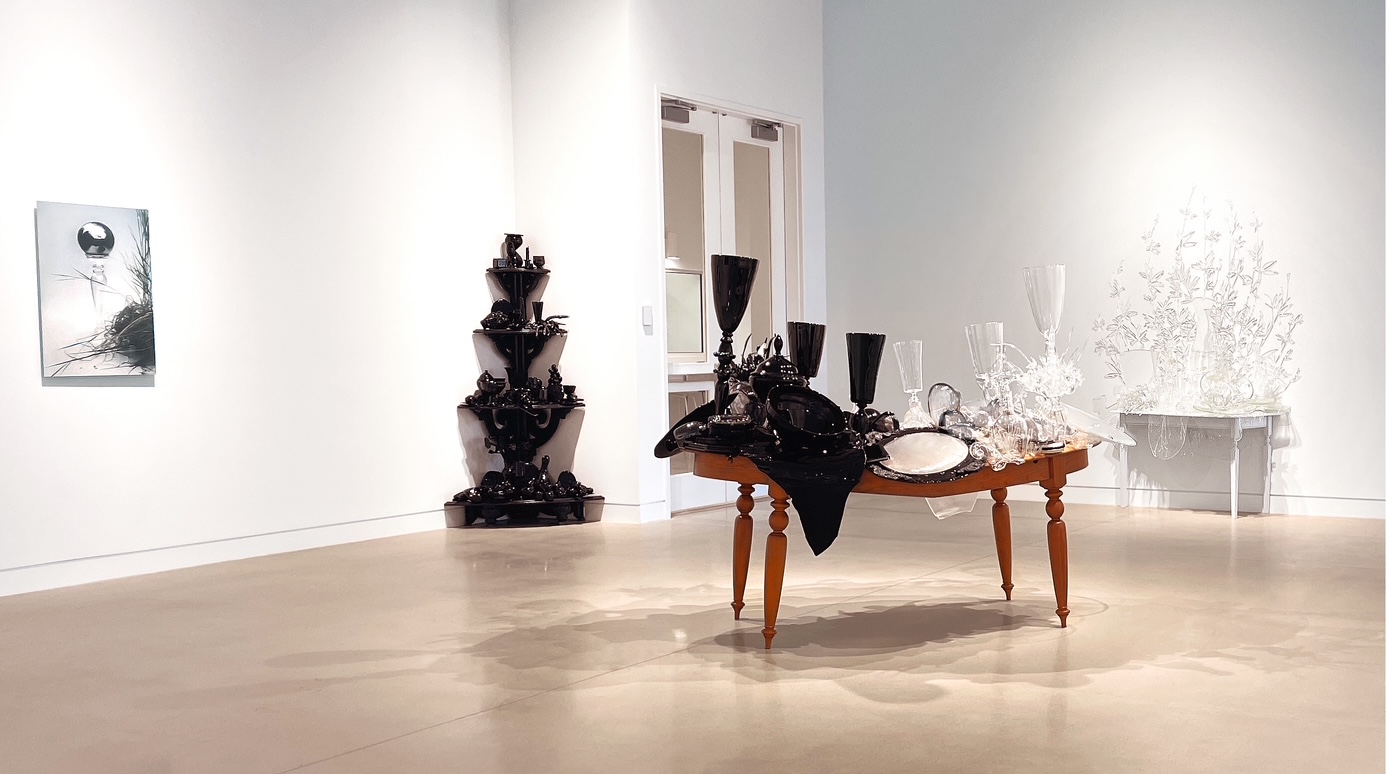
Artist Beth Lipman explores what it means to leave a mark on the world; what remains, what fades, and what defines a moment in human history.

Through intricate glass still lifes, Lipman creates sculptural time capsules that capture the natural and material objects shaping our present. Rooted in the tradition of still life, which has long attempted to preserve the temporary, Lipman’s work adds new layers of meaning by using glass: a material that can last for centuries or shatter in an instant. The tension between permanence and fragility underscores the inevitability of change and loss.

ABOUT BETH LIPMAN


American, b. 1971, New York, NY
lives and works in Sheboygan Falls, WI

Beth Lipman is an American artist whose sculptural practice generates from the Still Life genre, symbolically representing the splendor and excess of the Anthropocene and the stratigraphic layer humanity will leave on earth. Assemblages of inanimate objects and domestic interiors, inspired by private spaces and public collections, propose portraits of individuals, institutions, and societies.

Temporality and mortality-primary concerns linked to the Still Life tradition are heightened through materiality. Works in glass, wood, metal, photography, and video disrupt the mechanisms of fixed, grand narratives in order to emphasize evanescence at the heart of ‘vanitas’. Sculptural processes become analogies for life cycles, pointing to systems both natural and human that must continually adapt in order to survive.

The works are a meditation on our relationship to Deep Time, a monumental time scale based on geologic events that minimizes human lives. Each installation is a reimagining of history, created by placing cycles often separated by millennia in proximity, from the ancient botanical to the cultural. The incorporation of prehistoric flora alludes to the impermanence of the present and the persistence of life. The ephemera of the Anthropocene become a symbol of fragility as the human species is placed on a continuum where time eradicates hierarchy.

Lipman has received numerous awards including a USA Berman Bloch Fellowship, Pollock Krasner Grant, Virginia Groot Foundation Grant, and a Louis Comfort Tiffany Foundation Grant. She recently completed One Portrait of One Man, a sculptural response to Marsden Hartley for the Weisman Art Museum (MN). Lipman has exhibited her work internationally at such institutions as the Ringling Museum of Art (FL), ICA/MECA (ME), RISD Museum (RI), Milwaukee Art Museum (WI), Gustavsbergs Konsthall (Sweden) and the Renwick Gallery of the Smithsonian American Art Museum (DC). Her work has been acquired by numerous museums including the North Carolina Museum of Art, Brooklyn Museum of Art (NY), Smithsonian American Art Museum (DC), and the Corning Museum of Glass (NY).

KADRI PÄRNAMETS: MURAKA

KADRI PÄRNAMETS: MURAKA

on view at Ferrin Contemporary

Summer Gallery
54 Main Street
Cummington, MA

Ongoing

ABOUT THE EXHIBITION


CUMMINGTON, MA – Ferrin Contemporary is proud to present Kadri Pärnamets: Muraka, a new exhibition by one of Project Art’s resident artists. The exhibition features porcelain sculptures reflecting on the universal element of water and natural forms opening during Riverfest and Project Art’s Open House on Saturday, September 20th. The public is invited to a short talk with Kadri and gallery director, Leslie Ferrin followed by a reception at 4:30 pm. The exhibit is on view through November 15, 2025.

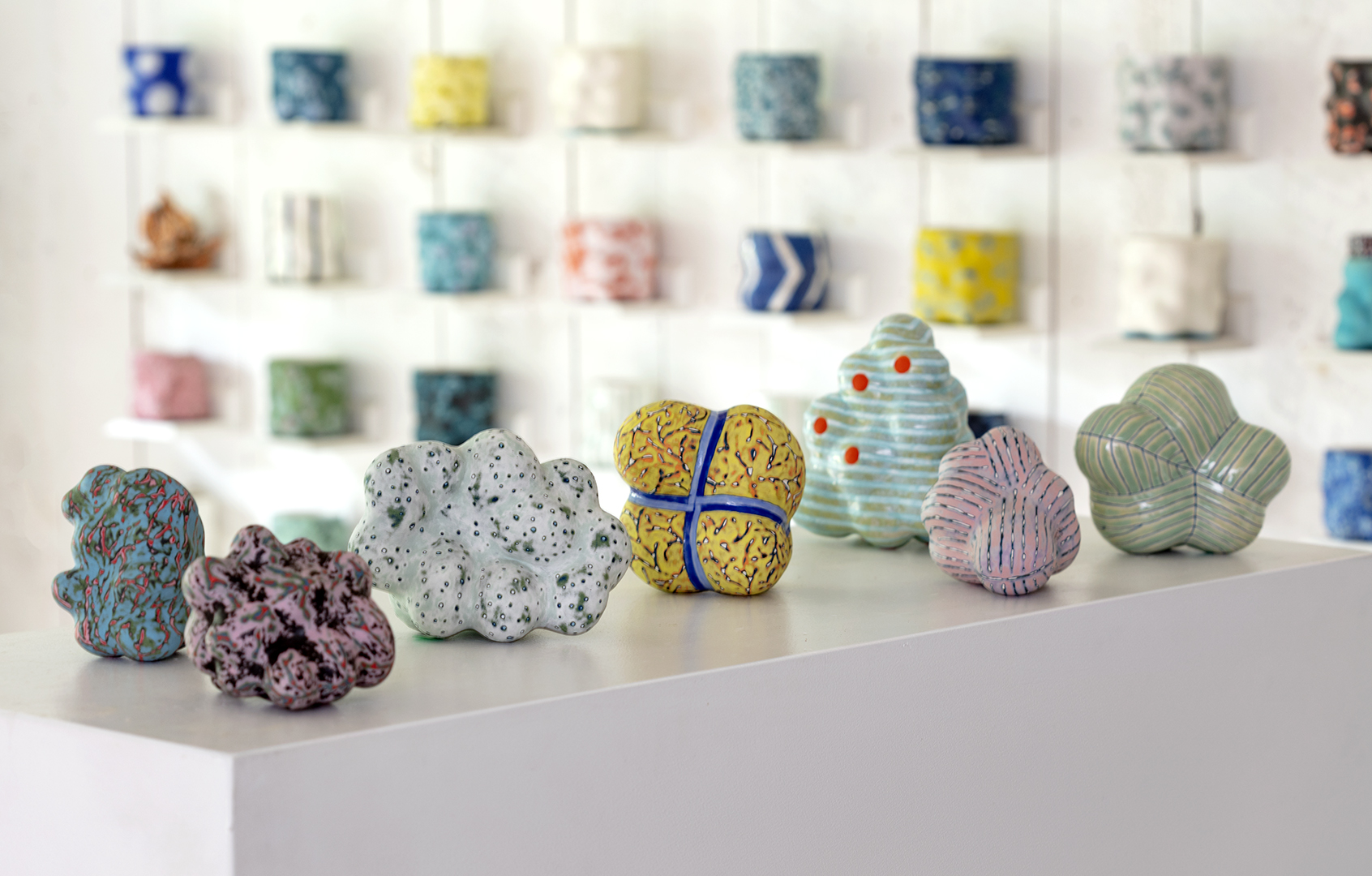
The exhibition builds on two bodies of work: Kadri Pärnamets: Choreography of Water, her 2022 solo show at Ferrin Contemporary in North Adams, Massachusetts, as well as her first site-responsive public art commission, Fire Sculpture at Claytopia at Guldagergaard in Skælskør, Denmark. The works in Muraka continue themes of abstract biomorphic forms inspired by water, air, and the changing environment of the river ecosystem. Pärnamets uses water as a metaphor; her multicolored surfaces and organic forms visually reference water’s vast, expansive body that connects land and sky and its forces that impact both protect and threaten the land, earth’s inhabitants and possibly humanity itself.

Ferrin Contemporary director Leslie Ferrin comments “Kadri’s grounding in her own environments in both Estonia and Cummington provides a deep foundation for her soft forms and surfaces. Straddling two worlds, her daily walks provide inspiration and the time for reflection as she watches the colors change and considers the impact on nature from the turbulent forces pulling us forward.”

Pärnamets chose the title for her exhibition Muraka, naming it after a place with special meaning for her in Estonia. Muraka is a nature reserve in her home country characterised by its wetlands, unspoilt forest and one of few remaining wilderness areas in north-east Estonia.

Kadri Pärnamets: Muraka includes her first large scale porcelain sculptures produced in 2025 with support from the A.R.T. 2025 grant from Berkshire Taconic Community Foundation. The funding provided time and materials to expand on two series 2024 that are included in the exhibition – Fragments of Waves and Frame of Mind series’. These pieces differ in form and scale while tracing a clear flow of consciousness from her past works. Works are placed in rows like thoughts drifting to the surface, contained in their individualism, but connected as part of a wider sea or ecosystem. Her surface treatments, which alternate between matte respites and shimmering, effervescent blue glaze, speak not only to the glimmer of sun on water, but to the changing environment back home in Massachusetts. Residing along the Westfield River, Pärnamets works amongst an everpresent soundtrack of the river’s current and the hush of waving willow trees. In the studio and on her daily walks through the neighborhood, she is always observing, listening, and finding inspiration in the acute timbres and textures of the changing New England seasons.

Kadri Pärnamets: Muraka opens during the RiverFest organized by Cummington Cultural District. The family-friendly, participatory day long programs celebrate the wild and scenic Westfield River that runs through the heart of Cummington, MA. Throughout the festival, artists, humanists, and scientists share their practices and knowledge as a frame for hands-on, experiential, and sensory experiences for participants across a variety of means of engagement, including workshops, walks, guided movement, performances, and public artworks. As part of this, Kadri and her husband, sculptor Sergei Isupov, will host a day-long RAKU firing. Participants may bring up to four bisqued ceramic pieces to glaze and fire during their chosen firing slot. Visit Project Art’s event page to learn more and register.

Pärnamets’ work has been shown internationally at the Estonian Museum of Applied Art and Design (Tallinn, Estonia), at the International Tea Trade Expo (Shanghai, China), at Guldagergaard in Skælskør, Denmark, and many others. Since 1996, she has participated in symposiums in Latvia, Lithuania, Estonia, Switzerland, USA, Norway, and Hungary. She graduated from the Art Institute of Tallinn, Estonia with a BA/MFA in Ceramics. Dividing her time between Estonia and the USA, her primary studio is the USA at Project Art in Cummington, MA. She is represented by Ferrin Contemporary.

PROGRAMMING


OPENING RECEPTION & ARTIST TALK

September 20, 2025
4:30-5:30pm

Join Kadri Pärnamets for an artist talk about her new exhibition, Kadri Pärnamets: MURAKA, in the Summer Gallery at Ferrin Contemporary. Kadri will speak about her new series of works in the show, her process, and her life in Western, MA.

PRESS


At Ferrin Contemporary, cloud-like porcelain sculptures take shape in Kadri Pärnamets’ ‘Muraka’

Exhibition inspired by rivers, seas and Estonian bog landscapes.

Estonian, b. 1968, Rakvere, Estonia
lives and works in Cummington, MA

Kadri Pärnamets works in porcelain using traditional hand building and sculpting techniques to combine surface and form. Her biomorphic, organic forms provide a means to convey her personal interests ranging from fragile, natural environments to female identity. Her surface treatments feature a range of gesture and expression with either abstract shape or narrative figure painting, inspired by painters from the European Renaissance and Impressionist eras, like Lucas Cranach the Elder and Edouard Manet.

Pärnamets’ work has been shown internationally at the Estonian Museum of Applied Art and Design (Tallinn, Estonia), at the International Tea Trade Expo (Shanghai, China), and many others. Since 1996, she has participated in symposiums in Latvia, Lithuania, Estonia, Switzerland, USA, Norway, and Hungary.

Pärnamets graduated from the Art Institute of Tallinn, Estonia with a BA/MFA in Ceramics. Dividing her time between Estonia and USA, her primary studio is the USA at Project Art in Cummington, MA. She is represented by Ferrin Contemporary.

BETH LIPMAN: One-Self I Sing

BETH LIPMAN: One-Self I Sing

BETH LIPMAN: One-Self I Sing

Muskegon Museum of Art
296 W. Webster Avenue
Muskegon, MI

On view permanently

ABOUT THE INSTALLATION


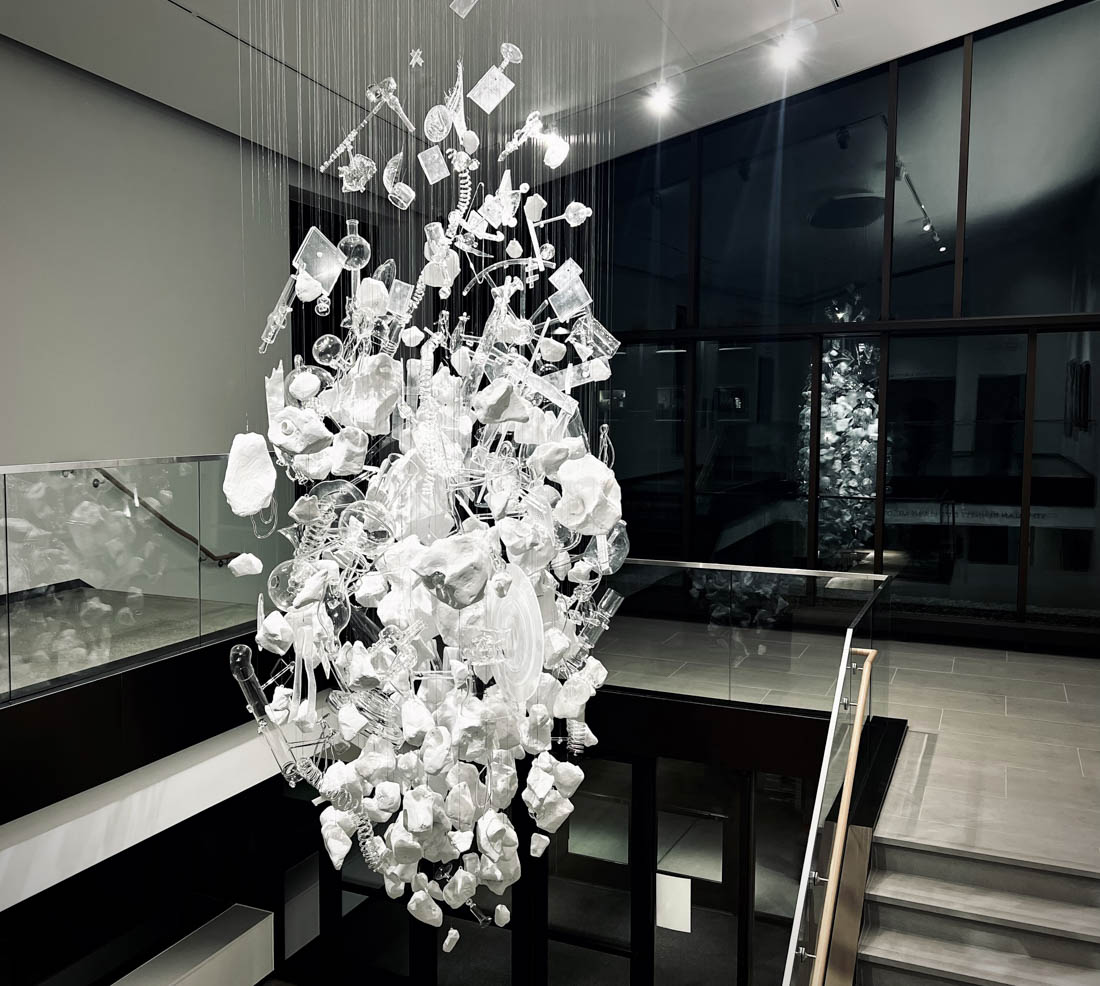
One’s-Self I Sing is a large-scale, site- specific installation that investigates the current moment in relation to Deep Time.  The sculpture, measuring approximately 180” x 120” x 48”, can be thought of as an “exploded” still life, a genre that holds the capacity to illuminate the ways that we understand our world through visual metaphors.

The sculpture will converge both floors of the new expansion, offering a visual continuity between multiple landings. Different aspects of the composition will be discovered upon entering the museum, ascending/descending the stairs or viewing from the second floor. Objects that reference to the Muskegon Museum of Art’s permanent collection will be incorporated. The marriage of transparent cultural objects and opaque rock formations alludes to what is seen and known juxtaposed with what is concealed and lost over time.

One’s-Self I Sing will be permanently installed in the Fall of 2024.

ABOUT BETH LIPMAN


American, b. 1971, New York, NY
lives and works in Sheboygan Falls, WI

Beth Lipman is an American artist whose sculptural practice generates from the Still Life genre, symbolically representing the splendor and excess of the Anthropocene and the stratigraphic layer humanity will leave on earth. Assemblages of inanimate objects and domestic interiors, inspired by private spaces and public collections, propose portraits of individuals, institutions, and societies.

Temporality and mortality-primary concerns linked to the Still Life tradition are heightened through materiality. Works in glass, wood, metal, photography, and video disrupt the mechanisms of fixed, grand narratives in order to emphasize evanescence at the heart of ‘vanitas’. Sculptural processes become analogies for life cycles, pointing to systems both natural and human that must continually adapt in order to survive.

The works are a meditation on our relationship to Deep Time, a monumental time scale based on geologic events that minimizes human lives. Each installation is a reimagining of history, created by placing cycles often separated by millennia in proximity, from the ancient botanical to the cultural. The incorporation of prehistoric flora alludes to the impermanence of the present and the persistence of life. The ephemera of the Anthropocene become a symbol of fragility as the human species is placed on a continuum where time eradicates hierarchy.

Lipman has received numerous awards including a USA Berman Bloch Fellowship, Pollock Krasner Grant, Virginia Groot Foundation Grant, and a Louis Comfort Tiffany Foundation Grant. She recently completed One Portrait of One Man, a sculptural response to Marsden Hartley for the Weisman Art Museum (MN). Lipman has exhibited her work internationally at such institutions as the Ringling Museum of Art (FL), ICA/MECA (ME), RISD Museum (RI), Milwaukee Art Museum (WI), Gustavsbergs Konsthall (Sweden) and the Renwick Gallery of the Smithsonian American Art Museum (DC). Her work has been acquired by numerous museums including the North Carolina Museum of Art, Brooklyn Museum of Art (NY), Smithsonian American Art Museum (DC), and the Corning Museum of Glass (NY).

BETH LIPMAN: Hive Mind

BETH LIPMAN: Hive Mind

BETH LIPMAN: Hive Mind

Iowa State University
1805 Center Drive
Ames, IA

August 25, 2025 – May 2027

ABOUT THE INSTALLATION


Hive Mind, a large-scale outdoor sculpture fabricated in bronze and glass, captures the dynamics of a highly organized social system, its circular form and rhythm evoking the perpetual cycles of production. The sculpture embodies the process of gathering, binding and conserving knowledge. Objects rise from and sink into the sculpture, hinting at how memory surfaces and recedes. Not everything is visible at all times to every viewer—an analogy for the elusive nature of memory.

Hive Mind celebrates Iowa State University’s legacy- its contributions and reverberations across critical disciplines such as science, technology and agriculture. Its genesis is its visual reference to the round hay bale, an innovation developed in the 1960’s by ISU professor Wesley Buchele. Like so many other breakthroughs, this one invention catalyzed its respective industry and revolutionized the act of harvesting. Positioned at the heart of campus, where all pathways converge, Hive Mind contains embedded clear glass objects that represent ISU’s past, present, and future.

A solo exhibition entitled Middle of the Story will be on view in the Christian Petersen Art Museum at Iowa State University beginning August 25, 2025.

ABOUT BETH LIPMAN


American, b. 1971, New York, NY
lives and works in Sheboygan Falls, WI

Beth Lipman is an American artist whose sculptural practice generates from the Still Life genre, symbolically representing the splendor and excess of the Anthropocene and the stratigraphic layer humanity will leave on earth. Assemblages of inanimate objects and domestic interiors, inspired by private spaces and public collections, propose portraits of individuals, institutions, and societies.

Temporality and mortality-primary concerns linked to the Still Life tradition are heightened through materiality. Works in glass, wood, metal, photography, and video disrupt the mechanisms of fixed, grand narratives in order to emphasize evanescence at the heart of ‘vanitas’. Sculptural processes become analogies for life cycles, pointing to systems both natural and human that must continually adapt in order to survive.
The works are a meditation on our relationship to Deep Time, a monumental time scale based on geologic events that minimizes human lives. Each installation is a reimagining of history, created by placing cycles often separated by millennia in proximity, from the ancient botanical to the cultural. The incorporation of prehistoric flora alludes to the impermanence of the present and the persistence of life. The ephemera of the Anthropocene become a symbol of fragility as the human species is placed on a continuum where time eradicates hierarchy.

Lipman has received numerous awards including a USA Berman Bloch Fellowship, Pollock Krasner Grant, Virginia Groot Foundation Grant, and a Louis Comfort Tiffany Foundation Grant. She recently completed One Portrait of One Man, a sculptural response to Marsden Hartley for the Weisman Art Museum (MN). Lipman has exhibited her work internationally at such institutions as the Ringling Museum of Art (FL), ICA/MECA (ME), RISD Museum (RI), Milwaukee Art Museum (WI), Gustavsbergs Konsthall (Sweden) and the Renwick Gallery of the Smithsonian American Art Museum (DC). Her work has been acquired by numerous museums including the North Carolina Museum of Art, Brooklyn Museum of Art (NY), Smithsonian American Art Museum (DC), and the Corning Museum of Glass (NY).