TCC Bulletin, 2025 Vol. XXVI No. 2
by Kory W. Rogers, Francie and John Downing Senior Curator of American Art, Shelburne Museum
CONFECTED, BORROWED & BLUE: Transferware by Paul Scott was on view at Shelburne Museum, Shelburne, VT
May 11 – October 20, 2024
Introduction
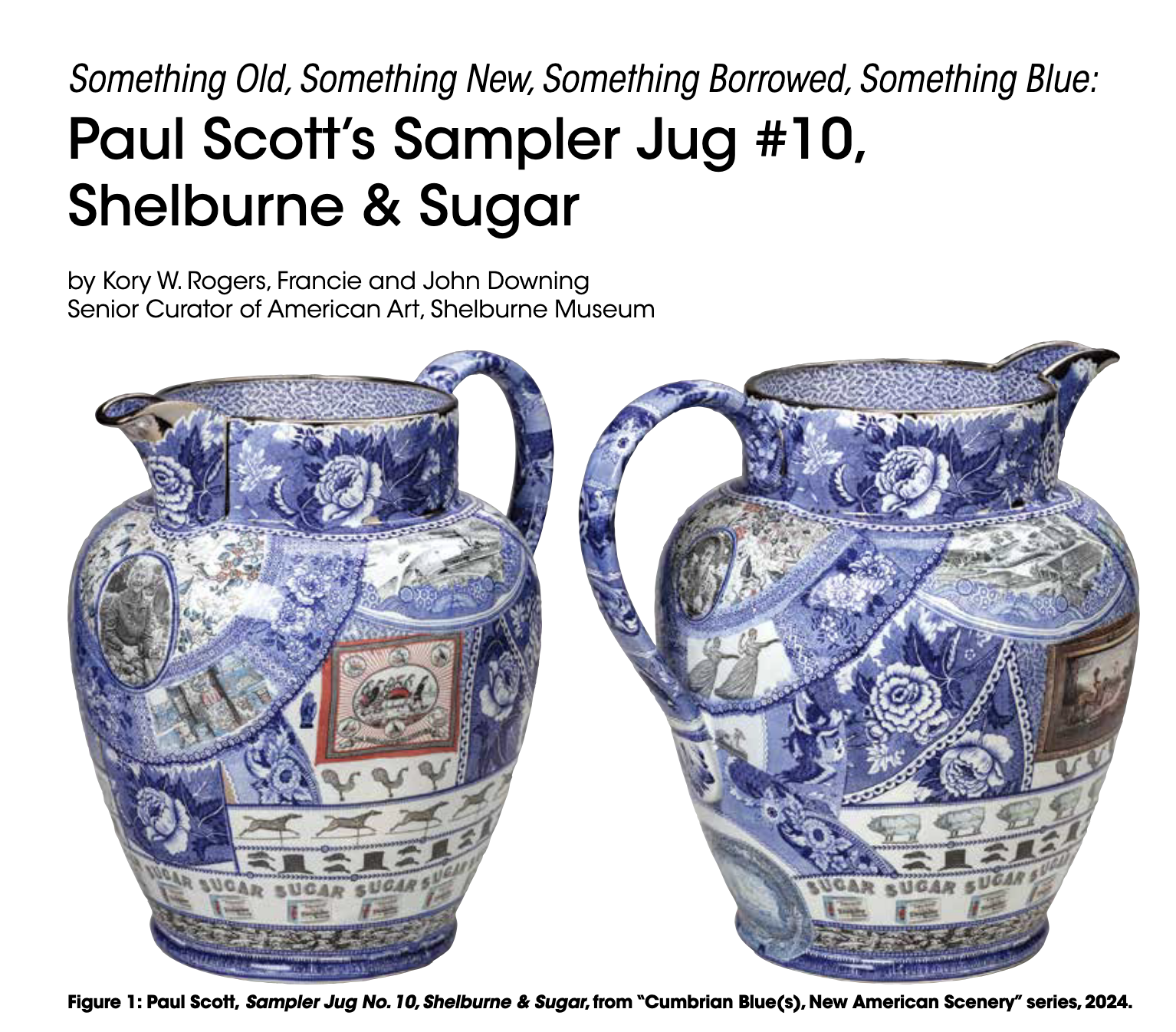
The contemporary transferwares of British ceramic artist Paul Scott call to mind the old Victorian wedding rhyme: “Something old, something new, something borrowed, something blue.” In Scott’s case, the “old” is the eighteenthcentury technique of transfer printing on ceramics; the “new” is the imagery and incisive commentary on contemporary social and political issues that he weaves so deftly into his work; the “borrowed” refers to the historical patterns and borders he repurposes and reframes; and the “blue” is, quite literally, the cobalt pigment so closely associated with historic British transferwares popular with the American market. By blending the old with the new, the traditional with the inventive, and the serious with the playful, Scott’s work resonates deeply with Shelburne Museum’s curatorial ethos—making history relatable through the stories embedded in objects from the past and today alike. It is fitting, then, that in 2023 Shelburne Museum in Shelburne, Vermont, commissioned Scott to create one of his large sampler jugs to honor museum founder, Electra Havemeyer Webb (1888–1960), the institution’s history, and some of its most iconic collection objects. To immerse himself in the unique complexity of Shelburne Museum, Scott traveled from his home and studio in Cumbria, England, to Vermont, where he spent a week exploring the museum’s 39 buildings and vast holdings of approximately 150,000 objects. He delved into archival materials and stayed at Mrs. Webb’s Vermont country home, the Brick House, where he experienced firsthand the origins of her “chock-ablock” aesthetic—a hallmark reflected in the jug’s final design.
Standing 15 inches tall, 14 inches in diameter (including its handle), and 11¾ inches across at its base, Sampler Jug #10, Shelburne & Sugar, is a profusion of patterns “harvested” from historical transferwares combined with imagery of important Museum collections objects (Figures 1A and 1B). The jug is a print collage under pearlware glaze with platinum lustre. In 2019, supported by a fabrication grant from the Alturas Foundation, Paul Scott collaborated with shape designer and product developer Ed Bentley to create a new large-scale jug form inspired by three historical examples. The jug was slip-cast and bisque-fired at Ceramics By Design, a small factory in Longton, Staffordshire. The pearlware glaze was then applied and fired in Scott’s studio in Cumbria, England, followed by the careful collaging of transfer prints (decals) before a final in-glaze firing to fuse the imagery seamlessly into the glazed surface Completed in spring of 2024, the bespoke jug became both the literal and figurative centerpiece of a temporary exhibition Confected, Borrowed, & Blue: Transferware by Paul Scott (on view from May 11 – October 20, 2024), pairing the artist’s contemporary works with selections from Shelburne’s historic American scene transferware collection (Figure 2).


Displayed in the Museum’s Variety Unit ceramics gallery, the exhibition was organized thematically, each case dedicated to important American political and social issues of the past and present. A Base Ingredient: Sugar and Shelburne Museum Three detailed views of Paul Scott’s jug are shown in Figures 3A, 3B, and 3C. There are 26 components imaged on the jug. A detailed key to the various components follows this article. Scott designed the jug’s narrative to unfold in chronological sequence, beginning at its base with references to the source of the inherited fortune that underwrote Mrs. Webb’s collecting. Her father, Henry Osborne “H.O.” Havemeyer (1847–1907)—a third-generation sugar refiner and industrialist known as “The Sugar King”—presided over the American Sugar Refining Company, or “U.S. Sugar Trust,” which at its height controlled nearly 98 percent of the nation’s refined sugar market. Although the Havemeyer family did not directly own enslaved individuals, the raw sugar their refineries processed was historically cultivated by enslaved African-Caribbean laborers and their descendants. In later years, the company’s monopolistic practices and market manipulation contributed to wage suppression and unsafe labor conditions. In an era increasingly attuned to social justice, environmental responsibility, and public health, the sugar industry’s legacy continues to invite critical reflection—its historic ties to slavery, environmental degradation, and the health effects of excessive sugar consumption remain deeply relevant. Through this thoughtful and provocative work, Scott both celebrates Electra Havemeyer Webb’s enduring vision for Shelburne Museum and invites contemplation of the complicated histories intertwined with cultural philanthropy and artistic patronage.
The Source of Inspiration Founded in 1947 by Electra Havemeyer Webb (1888–1960), Shelburne Museum is a remarkable treasure trove of American art and design spanning from the eighteenth century to the present day. Set on 45 acres in Vermont’s bucolic Champlain Valley, the Museum comprises 39 distinctive structures, 25 of which are historic buildings relocated to the site. Its holdings of roughly 150,000 objects encompass fine, folk, and decorative arts; miniature circus models; wildfowl decoys; horse-drawn vehicles; and the landlocked 220-foot steamboat Ticonderoga. Shelburne Museum’s collection of eighteenth- and nineteenth-century ceramics includes a rich array of English and American pottery, displayed throughout the domestic interiors of its historic homes and in the ceramics galleries housed in the Variety Unit. Among these are more than 250 examples of transferware decorated with American scenes in a range of colors. The most significant of these are featured in the Jug Room, which also contains an extraordinary group of 13 mammoth-scale ceramic jugs (trade signs) (Figures 4A and 4B). More than half of these monumental vessels are adorned with as many as three dozen different transferware scenes—including Paul Scott’s Sampler Jug #10, Shelburne & Sugar. ❖
Special Thanks The author would like to thank Alice Cooney Frelinghuysen, the Metropolitan Museum of Arts’ Andrew W. and Lulu C. Wang Curator of American Decorative Arts, and Shelburne Museum Trustee, for graciously donating the funds to commission this jug.