


ABOUT THE EXHIBITION
FEATURED ARTWORKS
Group Exhibition
Curated by Armando Perla & Michael Patten
The Indigenous Contemporary Art Biennial ( BACA ), 8th edition
Launched in 2012, the Indigenous Contemporary Art Biennial ( BACA ) is a Montreal-based non-profit organization (registered in 2016) that promotes the work of Indigenous artists. The biennial takes place every two years in various locations, with each iteration focusing on a specific theme. The event caters to an increasingly broad audience—Indigenous and non-Indigenous—and showcases both emerging and established artists. Their mission is to promote Indigenous art and raise awareness and educate the public about First Nations cultural issues.
The Indigenous Contemporary Art Biennial ( BACA ) wishes to thank the Canada Council for the Arts, the Government of Quebec (Quebec Arts and Letters Council), the Montreal Arts Council, Tourisme Montréal, Desjardins Collection.
FEATURED ARTISTS
Tessa Alexander
Arawhetū Berdinner
Jacqueline Bishop
Josue Castro
Silvia Caxi
Filiberto Chali
Venuca Evanan
Carlos Lara
Luisfer Morales
Ehikoo Odeh
Jakob Olive
Paula Rivera
TRAMA Textiles
Matt Tini
ARIA XYX


INSTALLATION IMAGES


MORE ON THE EXHIBITION AND FEATURED ARTWORK
Markets of Memory: The Archive of Exchange
Situated above an active public market, this exhibition approaches the market as a living Indigenous archive shaped through trade, movement, and women’s knowledge systems. Across Mesoamerica and beyond, markets have long functioned as spaces where Indigenous women sustained economies, preserved ceremonial materials, transmitted artistic and medicinal knowledge, and maintained cultural continuity despite colonial disruption.
Rather than treating exchange as separate from culture, the works presented here understand circulation itself as a form of memory. Textiles, foodways, fibres, adornment, plants, and handmade objects move through relationships of barter, care, and reciprocity that continue to structure Indigenous life across territories. Throughout the exhibition, adornment appears as a living market practice, circulating through powwows, Indigenous trade networks, street markets, and intergenerational systems of making that connect aesthetics, ceremony, and exchange. In this context, the market operates simultaneously as school, social infrastructure, ceremonial site, and public space of Indigenous presence.
The exhibition also challenges museum models rooted in accumulation and permanence. Value emerges through movement, reuse, encounter, and redistribution. Through sculpture, textile, installation, adornment, and performance, the artists foreground economies grounded in relationality and survival, where objects remain alive through exchange and where women’s labour continues to sustain collective memory across generations.
The Market Woman
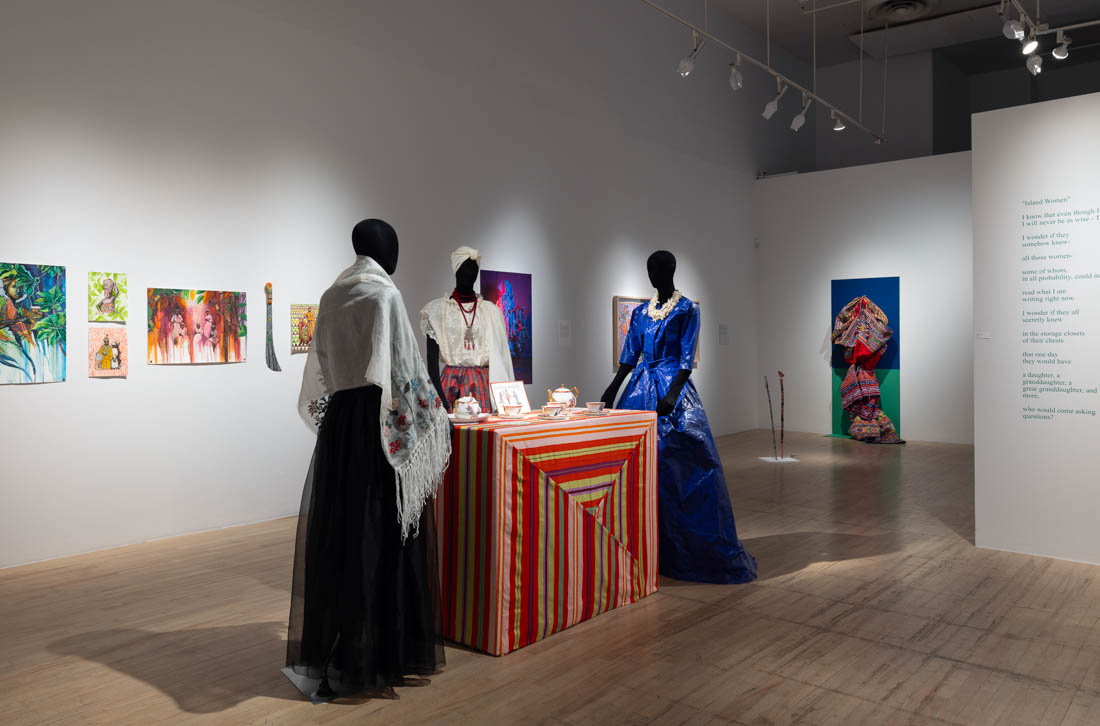
Centered around artist and scholar Jacqueline Bishop’s Fauna (2024) tea service and related textile, painting, and poetic works, this installation examines the market woman as a keeper of botanical knowledge, reproductive autonomy, and cultural continuity within the violent economies of colonialization, the transatlantic slave trade and plantation economies. Works such as The Keeper of All the Secrets (2023), printed on Sea Island cotton, foreground the exchanges of plant knowledge between Indigenous women of Abya Yala and forcibly displaced African women, tracing how these forms of knowledge became crucial to survival, healing, and reproductive care within the Caribbean. Bishop follows how these systems of medicinal practice and communal support moved through markets, shaping Caribbean women’s worlds across generations. Within these histories, Black women used plants, herbs, and market exchange networks to regulate fertility, terminate pregnancies resulting from sexual violence, and sustain forms of care excluded from colonial archives.
Installed on a textile by Trama Textiles, a cooperative of Maya women weavers formed during the Guatemalan genocide, the tea service situates women’s knowledge within broader Indigenous and diasporic systems of survival carried through markets, fabric, foodways, and oral transmission. Bishop’s paintings, garments, and poem Island Women extend this reflection, foregrounding women whose knowledge circulated through gesture, memory, and trade despite displacement and rupture.
Surrounding the installation, works by Black women artists including Ehiko Odeh and Tessa Alexander further engage plant knowledge, market economies, and the layered relationships between Blackness and Indigeneity across the Caribbean and the broader African diaspora. Together, the works ask what it means to remain Indigenous after forced displacement, enslavement, and rupture from ancestral territories, foregrounding the market as a space where memory, land-based knowledge, and cultural continuity continue to be carried through women’s labour and exchange.
ABOUT JACQUELINE BISHOP

Jacqueline Bishop is an accomplished writer, academic, and visual artist with exhibitions in Belgium, Morocco, Italy, Cape Verde, Niger, USA, and Jamaica. In addition to her role as Clinical Full Professor at New York University, Jacqueline Bishop was a 2020 Dora Maar/Brown Foundation Fellow in France; 2008-2009 Fulbright Fellow in Morocco; and 2009-2010 UNESCO/Fulbright Fellow in Paris. Bishop has received several awards, including the OCM Bocas Award for her book “The Gymnast & Other Position”, The Canute A. Brodhurst Prize for short story writing, The Arthur Schomburg Award for Excellence in the Humanities from New York University, A James Michener Creative Writing Fellowship, as well as several awards from the Jamaica Cultural Development Commission. Jacqueline’s recent ceramic work consists of brightly colored bone China plates used symbolically in Caribbean homes and explores how they hid the violent legacy of slavery and colonialism in the Atlantic world.