

Berry Campbell
524 W 26th Street
New York, NY
April 23 – May 30, 2026
ARTIST TALK WITH CURATOR GLENN ADAMSON
Saturday, May 16 | 3PM
At Berry Campbell

ABOUT THE EXHIBITION
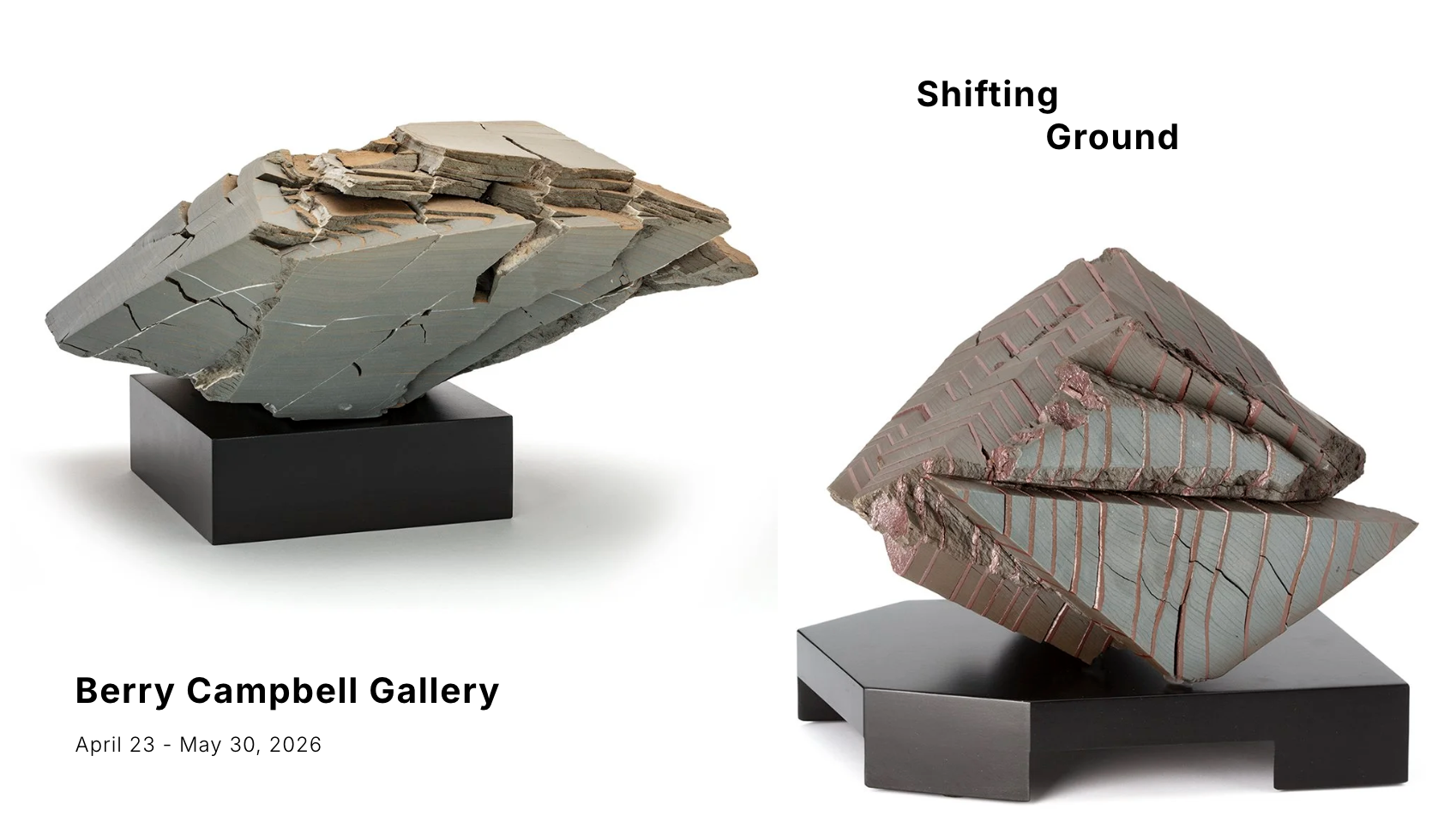
Berry Campbell is pleased to present a focused exhibition of porcelain sculptures by Sally Silberberg, an extraordinary and largely unseen body of work that marks a pivotal moment in the artist’s practice. The exhibition is curated by Glenn Adamson, an independent curator, writer, and historian, and previously Director of the Museum of Arts and Design and Head of Research at the Victoria and Albert Museum, London. The exhibition is accompanied by a 72-page catalogue.
Created during the 1980s, a concentrated period of experimentation for Silberberg, these sculptures are a decisive shift away from functional ceramics and toward a radical new sculptural language. After years of working on the potter’s wheel, Silberberg developed a new method built from solid blocks of porcelain. Layered with pigment, cut, torn, and carved, each work introduces both risk and unpredictability and pushes porcelain to its structural and perceptual limits.
These works challenge perception, and Silberberg asks whether porcelain, “an elegant material hovering between rough clay and glass” as the artist put it, could instead be experienced as dense and geological. The resulting sculptures are angular, striated, and weighty, their layered surfaces and sharp angles evoking fractured stone or exposed strata. Both controlled and unstable, the sculptures balance precision with disruption, and give the impression of forms under pressure caught in a state of continual transformation.
While firmly rooted in ceramic tradition, these works also engage with broader currents in postwar and 1980s art. Disorienting spatial collisions reference Cubism, exposed stratigraphy can be read in relation to the work of Naum Gabo, and the works’ activated grids and stripes relate to patterns of 1980s design and architecture. The exhibition’s curator, Glenn Adamson, calls her more of “a deconstructivist than a constructivist” and relates her orchestration of chance and control to that of Gerhard Richter.
Works from this series are in the collections of the Brooklyn Museum and the Smithsonian. Silberberg’s porcelain sculptures constitute a distinct and powerful body of work that expands the possibilities of porcelain and marks a pivotal moment in sculptural achievement.


EXHIBITION CATALOG

Sally Silberberg: Shifting Ground
-
Introduction by Tara Silberberg
-
Essay by Glenn Adamson
-
Designed by Mikulak Design
-
Photography by John Polak
-
Published by Berry Campbell
-
Printed by MIXAM
Excerpt from Deep Cut
By Glenn Adamson
Silberberg already had extensive experience with porcelain, having used it for her functional pottery, and it was porcelain – “an elegant material, hovering between rough clay and glass,” as she puts it – that now absorbed her full attention. Rather than throwing on the wheel, she began to build forms by hand. She first formed the recalcitrant clay into blocks, then sliced these into thinner sheets, layering them with veins of tinted oxide and restacking them. Finally, she carved the composite mass in an intuitive but exacting manner. The initial results were promising: small works, roughly triangular in section and tilting upward from the base, as if extruded by some invisible force. Working at the wheel, she trimmed out a central cylinder from each of these pieces, opening the possibility of using them as containers, while also giving the impression that they had been drilled out or core-sampled.
From there it was a matter of scaling up and developing the language, which Silberberg did with extraordinary boldness. After letting the clay dry to leather-hard stage, she carved into it using a plaster spatula and rubber mallet. Here and there she would tear out a section, leaving behind a rough, self-generated texture; flat planes were sanded perfectly smooth once the clay was bone dry. The challenge was to prevent the works from cracking or even exploding in the kiln. Even a small air pocket, if trapped within the clay, will expand as it heats and send fissures radiating outward. Through trial and error, Silberberg realized that the internal seams of her sculptures allowed small amounts of air to escape; the porcelain fused back together at higher temperatures, restoring the work to solidity. Each piece was a risk (and not all of them did survive firing), but by exploiting this technical effect she was able to construct larger and larger pieces, eventually doing away with the cylindrical voids in their core, and thus any lingering reference to the vessel. At the same time she was broadening her palette, adding colorants into the porcelain to produce grays, blues, browns, and a striking chrome green. The technique is comparable to historic British agate ware, though she says she was more inspired by the use of pigmented clay in modern Japanese ceramics.
ABOUT SALLY SILBERBERG

American, b. 1945, Syracuse, NY
lives and works in Plainfield, MA
Sally Silberberg began her professional career in 1969 as a traditional production stoneware potter producing utilitarian forms. Through the following decade, she began working translucent porcelain, her glazes became painterly abstractions, and her pots became vessels. In the early 80’s, Silberberg experimented with nerikomi, a technique uniting her interests in color and sculptural form. Exploring the vulnerabilities of the clay material through large scale solid forms and movement in the firing process, her work became an amalgam of fissures and disruptions of lines that converged three-dimensional forms. The tension between graphic, two-dimensional patterning within a three-dimensional structure led Silberberg to painting, which thirty-years later, is a continuation of the energy that grew from the works in clay.
Silberberg’s ceramic sculpture has been exhibited internationally at the Everson Museum, (Syracuse, NY), the Woodmere Museum, (Philadelphia, PA), East-West Contemporary Ceramics Exhibition, (Mino, Japan), the Parrish Art Museum, (Southampton, NY), and the Institute of Design, (Sacramento, CA). She has received numerous awards, including a fellowship from the Massachusetts Artists Foundation. In 1967, Silberberg graduated with a BFA in ceramic design from the New York State College of Ceramics at Alfred University. Her studies included a year abroad at Nyckelviksskolan, Stockholm, Sweden and an introduction to modernist aesthetics. Silberberg’s first small studio in Brooklyn, NY, the Clay Pot, moved to Plainfield, MA in 1974.