

Like our clients, we are passionate about ceramics and maintain a collection of our own, curated and built throughout our gallery’s 40-plus-year story. View below to see examples of the Ferrin Contemporary Historical Collection, and contact us if you are interested in loaning pieces from our collection for exhibition or for additional details.
ABOUT THE COLLECTION
Works from Ferrin Contemporary’s Resources and Collections are lent to museum exhibitions that feature works by contemporary artists represented by the gallery. The collection began decades ago with souvenir plates and developed further when sourcing material for Paul Scott to use in his New American Scenery series. The series is now on tour at museums that invite Paul to collaborate as an artist curator to select works from their permanent collections to be shown in context with his prints on ceramics, photogravures and re-animated historic transferware. An Enoch Woods, Cape Coast Castle platter depicting the slave trade in Africa was first found by Paul when researching the transferware collection at RISD Museum. A copy of that platter is available for loan and is included in his comprehensive show at the Albany Institute of History and Art.
At Ferrin Contemporary, the exhibition Our America/Whose America? invited artists to respond to this collection with newly created and recent works that directly questioned the presumptions conveyed by the historic material. At Norman Rockwell Museum feature in Imprinted: Illustrating Race is a case of ceramic, glass and other manufactured objects in conversation with contemporary works by Elizabeth Alexander, Garth Johnson and Paul Scott. The collection includes souvenir objects and plates, designed and produced in England in the 19th and early 20th century, Made in Occupied Japan, and later produced in America. The series produced by Vernon Kilns designed by Rockwell Kent and Gale Turnbull “Our America” is featured in the two exhibitions on view in 2022.
Looking around at the contemporary exhibition landscape, we are in a moment of reflection. In museums and galleries throughout the Americas, artists are using found objects and repurposing materials in their work. Likewise, museum curators are looking at their permanent collections to both critique the featured content and question the paths of patronage and origin stories. Diversifying permanent collections to address past gaps and omissions through new acquisitions of works by women and artists of color. Commissioning contemporary artists to produce site responsive works or supporting their practice by placing them in the role of artist-curator is providing opportunities for scholarship and engagement with new audiences. Together as we all reflect on the past by examining what was hidden in plain sight, we move forward, informed of the forces that still impact our lives today.
Leslie Ferrin, Director of Ferrin Contemporary, Collector
DIRECTOR’S STATEMENT
More than 40 years ago, an artist friend pointed out the differences between a polychrome (lots of colors) transfer printed souvenir plate and others that were monochrome (one color). The artist, Miriam Kaye, was known for reuse of images from history in her own work, along with reclaimed material collage. I don’t recall the image on the plate but I do remember her introduction to the subtle variations of surface, under and over glaze, printed imagery, and the quality of the plates themselves. Depending on the time period when they were produced, each decade built upon a prior narrative to commemorate idealized versions of historic events, portraits of “founders,” man-made monuments and the buildings built, some named for and intended to honor this history. These plates were created as souvenirs with clues to their origins on the backs of plates through merchant stamps, or maker’s marks, and sometimes additional narratives with lengthy written text. This information, further emphasized by titles and relationships with the visual imagery, was quite literally whitewashed of any human struggle that came before, during, or after. Some commemorated foot soldiers who fought for independence, others were generals and represent what we now view as white supremacy by glorifying slave owners and the confederacy.
These images were created and put on plates using illustrations, sometimes copies of well known paintings and entered popular culture as countless multiples. They used powerful stereotypes and caricatures, added to historical fictions and resonate today as we consider how we came to believe what we do.
The first versions produced in the early 1800s by British potteries were designed in written correspondence that used illustrations and prints provided by the merchants. They would correspond by post with the engravers prior to ordering inventory for shops and stores in the US. These were sometimes based on well known history paintings and with each transmission, the narrative and image was popularized and imprinted on new generations. By the early 1900’s the compositions became formulaic using medallions on the plate’s border format to layer on more information, providing additional opportunities to romanticize what was quickly receding into the past.
From the mid-70’s on, I collected, was given and sent more than 100 plates, figurines, and small objects in glass and ceramics. This started casually. Like others of my generation who hunted and gathered vintage materials, we sought cultural objects that reminded us of a past that many of us never actually experienced but for which were nostalgic without fully understanding the depth of that past. We saw the irony and displayed these objects in our homes, naive and unaware of their toxic power to continue the original message conveyed and widely distributed through commercial reproduction.
At first, most of the souvenir plates I purchased were produced by English potteries like Johnson Brothers and Rowland & Marsellus who operated in the early 1900s, commissioned by merchants to offer for sale to tourists at the sites depicted. The plates I purchased showed monuments and architecture flanked by their namesakes, generals and politicians; scenes copied from famous paintings such as the landing of Europeans – Roger Williams, Henry Hudson; portraits such as Pocahontas/Matoaka depicted as an Englishwoman copied from an engraving by Simon van de Passe; geographically significant landscapes tamed by Europeans such as Plymouth Rock with 1620 carved into it and Mount Rushmore with the faces of the founders, Niagra Falls now accessible by boat and generating electricity. These images are about American identity which led me to seek out others, plates and figurines made in America and Occupied Japan drawn as I was to how they represented and portrayed race, positions in society, and through popular culture continue to infuse tropes, maintain stereotypes and deliver messages “hidden in plain site.”
What started as a hobby that gave me an excuse to poke around thrift stores, antique malls and buy things when I traveled, became a collection – these plates were a way to connect with a past I never personally knew but was represented by the center images, surrounding cartouches or medallions and back stamps. In 2020, when the pandemic froze us all in place, my collecting took a turn. Working from home, with my lived through 40 years in ceramics, and my new perspectives delivered though the BLM movement, I began to turn this old hobby into a site of investigation and criticality. The result is OUR AMERICA/WHOSE AMERICA? Though as we have worked our way through the historic materials and the layered responses from artists, we realize this might be a starting point and not an end point type of exhibition.
Looking around at the contemporary exhibition landscape, it’s clear we are having a moment of reflection. One only need look at our collaborators like Jack Shainman Gallery, The Norman Rockwell Museum and The Albany Institute History and Art, or out across the country to other sites like MCA Chicago, The Cleveland Institute of Art, and dozens more who are also hosting exhibitions that look at and celebrate the new Black vanguard and honor other living, contemporary artists who have historically been marginalized.
–Leslie Ferrin
HISTORICAL COLLECTION FEATURED IN MUSEUMS & GALLERIES


IMPRINTED: ILLUSTRATING RACE
2025 | Exhibition at the Delaware Art Museum | Wilmington, DE
Oct 18, 2025 – Mar 1, 2026
The Norman Rockwell Museum assembled Imprinted: Illustrating Race with co-curator Robyn Phillips-Pendleton, a professor at the University of Delaware. The exhibition honors Rockwell’s powerful images supporting the Civil Rights Movement, displaying his work within a sweeping historical survey of American illustration that features illustrators including Romare Bearden, Emory Douglas, Howard Pyle, and Loveis Wise.
Illustration has been at the forefront of defining events in the United States, from the American Civil War and Reconstruction Era to the Harlem Renaissance and the Civil Rights Movement of the 1960s, moving forward to today. Imprinted examines widely circulated imagery, conceived and published over the course of more than three centuries, which has reflected and shaped perceptions of race across time.
Featuring over 200 artworks commissioned by publishers and advertisers, the exhibition traces harmful and prolific stereotypical representations of race that were historically sanctioned and prominently featured in newspapers, magazines, and books, on trade cards, posters, and advertisements, and on packaging and products. Imprinted also celebrates the concerted efforts of 20th and 21st century artists and editors to shift the cultural narrative through the publication—in print and across digital platforms—of positive, inclusive imagery emphasizing full agency and equity for all.
Imprinted: Illustrating Race includes works from the Ferrin Contemporary Historical Collection as well as recent contemporary works from Ferrin Contemporary artists. The collection includes souvenir objects and plates, designed and produced in England in the 19th and early 20th century, Made in Occupied Japan, and later produced in America. These objects were exhibited at the Normal Rockwell Museum in the 2023 location of “Imprinted”, and in Ferrin Contemporary’s traveling exhibition, “Our America/Whose America” (2022 & 2024).


OUR AMERICA/WHOSE AMERICA?
2024 | Group Exhibition in the Wickham House at the Valentine Museum | Richmond, VA
February 20, 2024 – April 21, 2024
Our America/Whose America? Is a “call and response” exhibition between contemporary ceramic artists and commercially produced historic ceramic plates, figurines, and objects placed in conversation with one another. The exhibition can be modified by location to address regional issues relevant to the local communities in which it’s displayed.


IMPRINTED: ILLUSTRATING RACE
2022 | Exhibition at the Norman Rockwell Museum | Stockbridge, MA
June 11, 2022 – October 30, 2022
Imprinted: Illustrating Race examined the role of published images in shaping attitudes toward race and culture. Over 300 artworks and objects were on view of widely circulated illustrated imagery, produced from the late eighteenth century to today, which have an impact on public perception about race in the United States. The exhibition explored stereotypical racial representations that have been imprinted upon us through the mass publication of images. It culminated with the creative accomplishments of contemporary artists and publishers who have shifted the cultural narrative through the creation of positive, inclusive imagery emphasizing full agency and equity for all.
Imprinted: Illustrating Race includes works from the Ferrin Contemporary Historical Collection as well as recent contemporary works from Ferrin Contemporary artists. The collection includes souvenir objects and plates, designed and produced in England in the 19th and early 20th century, Made in Occupied Japan, and later produced in America. These objects were exhibited at the Normal Rockwell Museum in the 2023 location of “Imprinted”, and in Ferrin Contemporary’s traveling exhibition, “Our America/Whose America” (2022 & 2024).


OUR AMERICA/WHOSE AMERICA?
2022 | Group Exhibition at Ferrin Contemporary | North Adams, MA
Our America, Whose America presents a dialogue between contemporary artists and a collection of commercially produced ceramics. This collection of historical objects, collected across the span of several years by Founding Director Leslie Ferrin, is in the form of plates, souvenirs, and figurines from the early 19th through mid-20th centuries. The items were produced in England, Occupied Japan, and various factories in the USA. The exhibition title was chosen from a series of plates produced by Vernon Kiln that features illustrations of American scenes by the painter Rockwell Kent.
In response to this historical collection, contemporary works by nearly 30 participating artists will provide new context and interpretation of these profoundly powerful objects. Seen now, decades and in some cases centuries later, the narratives they deliver through image, characterization, and stereotype, whether overt and bombastic or subtle and cunning, form a collective memory that continues to impact the way people see themselves and others today.
PITCHERS & SERVICEWARE
More than 40 years ago, an artist friend pointed out the differences between a polychrome (lots of colors) transfer printed souvenir plate and others that were monochrome (one color). The artist, Miriam Kaye, was known for the reuse of images from history in her own work, along with reclaimed material collage. I don’t recall the image on the plate but I do remember her introduction to the subtle variations of surface, under and over glaze, printed imagery, and the quality of the plates themselves. Depending on the time period when they were produced, each decade built upon a prior narrative to commemorate idealized versions of historic events, portraits of “founders,” man-made monuments and the buildings built, some named for and intended to honor this history. These plates were created as souvenirs with clues to their origins on the backs of plates through merchant stamps, or maker’s marks, and sometimes additional narratives with lengthy written text. This information, further emphasized by titles and relationships with the visual imagery, was quite literally whitewashed of any human struggle that came before, during, or after. Some commemorated foot soldiers who fought for independence, others were generals and portraits of men and their properties. From a contemporary perspective, we now see these narratives as glorification of broken treaties, enslavers and the Lost Cause of the Confederacy.
These images were created and put on plates using illustrations, sometimes copies of well-known paintings and entered popular culture as countless multiples. They used powerful stereotypes and caricatures, added to historical fictions and resonate today as we consider how we came to believe what we do.
— Leslie Ferrin, Director & Collector


Rowland & Marsellus & Co. 1492 Pitchers
(Green Pitcher, pictured left)
“Discovery of America” Pitcher (Descriptive)
Artist Imported by the, Rowland & Marsellus Company, United States, New York, active 1893 – 1938 / Staffordshire, England
Medium lead-glazed earthenware, transfer-printed
7 5/8 × 7 × 5 1/2″
Birmingham Museum of Art
Staffordshire, Imported by the Rowland & Marsellus Company
1908


Amherst College Plates | Syracuse | Walker China
Amherst College salad or appetizer plate, sometimes referred to as the “Fleeing Indians” pattern and notated made by Walker China. It depicts British Army officer Baron Jeffrey Amherst on horseback, chasing native Americans through pine forests during the French and Indian War.
“SOUVENIR” PLATES & TRANSFERWARE
At first, most of the souvenir plates I purchased were produced by English potteries like Johnson Brothers and Rowland & Marsellus who operated in the early 1900s, commissioned by merchants to offer for sale to tourists at the sites depicted. The plates I purchased showed monuments and architecture flanked by their namesakes, generals and politicians; scenes copied from famous paintings such as the landing of Europeans – Roger Williams, Henry Hudson; portraits such as Pocahontas/Matoaka depicted as an Englishwoman copied from an engraving by Simon van de Passe; geographically significant landscapes tamed by Europeans such as Plymouth Rock with 1620 carved into it and Mount Rushmore with the faces of the founders, Niagra Falls now accessible by boat and generating electricity. These images are about American identity which led me to seek out others, plates and figurines made in America and Occupied Japan drawn as I was to how they represented and portrayed race, positions in society, and through popular culture continue to infuse tropes, maintain stereotypes and deliver messages “hidden in plain site.”


Souvenir & Transferware Plates | Regional Content
Pair of plates, Rowland and Marsellus Company, Staffordshire, England
1906
whiteware
10″.
One plate has a transfer-printed portrait of Pocahontas as the central motif, the other has John Smith, both with surrounding cartouches. The legend of the Pocahontas plate includes both her given name, Matoaka, and the one she received after baptism, “Rebecka” or Rebecca. Produced for the S. T. Hanger Company of Portsmouth, Virginia.


Adams, The Shrine of Democracy (Mount Rushmore)
Collectable 10″ ceramic transferware depicting Mount Rushmore. Produced in the United Kingdom by Adams, these souvenir plates feature the four U.S. Presidents’ faces in the Black Hills, SD, usually marked “Old English Staffordshire Ware”.

Johnroth English Staffordshire Mohawk Trail 7 3/4 Souvenir Plate
c. 1910-1915
transferprinted earthenware, glaze
7.5″ diameter

Mohawk Indian Trail Berkshires Plate, Rowland & Marsellus & Co
c. 1900
transferprinted earthenware, glaze
9″
The front of the plate reads, “Mohawk Trail Thru The Berkshires The Mohawk Indian”. The images depict various locations across Berkshire County, Massachusetts, labeled “Curve of Beauty Mohawk Trail”, “Hair Pin Turn Mohawks Trail”, “Cold River Glen Mohawk Trail”, and “Whitcomb Summit Mohawk Trail”.

Enoch Wood & Son, America Independent July 4 1776
1900
transfer printed earthenware, glaze
10.5″

Souvenir plate, Bermuda Alias Somers Island 1609 1909 Sir George Somers (Rowland & Marsellus & Co.)
ceramic
10 x 10 x 1″

Souvenir, Plymouth Mass 1907 (Rowland & Marsellus & Co.)
ceramic
10 x 10 x 1″

Souvenir of Plymouth Mass, Landing of the Pilgrims (John Roth, Old Stafforshire Ware)
c.1905
ceramic
9.25 x 9.25 x 0.75″
Vintage Landing of the Pilgrims at Plymouth Rock Flow Blue Souvenir Plate Jon Roth. The piece is marked on the back with the Old English Staffordshire Ware Jon Roth mark.

Souvenir, Souvenir of LEWIS & CLARK CENTENNIAL Portland, OR 1905, Staffordshire
1905
10 x 10 x 1″
On June 1, 1905 the first World’s Fair to be held in the Pacific Northwest, the Lewis and Clark Centennial and American Pacific Exposition and Oriental Fair, opened in Portland, Oregon. The goal of the exposition was to promote Portland as the commercial hub of the Pacific Northwest and the centennial of Lewis and Clark’s historic journey across the continent in 1805 provided a perfect theme. One of the most desirable and collectible souvenirs of that Fair is this Flow Blue plate, 10″ in diameter, featuring Lewis and Clark with Lady Liberty at the ocean’s edge in the center. Around the edges are portraits of Jefferson, Teddy Roosevelt, Washington, Lewis and Clark along with state seals of Oregon, Montana and Idaho and a mountain scene.

Souvenir, James Wood, Bennington Battle Monument, John Stark and Ethan Allen
1905
9.75″
Blue and white transfer plate of Bennington Battle Monument in Vermont.

Souvenir, Staffordshire, Landing of Roger Williams 1636
10″
Rowland & Marsellus blue transfer plate “Landing of Roger Williams 1636”
Collection of Leslie Ferrin/Ferrin Contemporary
OBJECTS & SCULPTURE
From the mid-70’s on, I collected, was given and sent more than 100 plates, figurines, and small objects in glass and ceramics. This started casually. Like others of my generation who hunted and gathered vintage materials, we sought cultural objects that reminded us of a past that many of us never actually experienced but for which were nostalgic without fully understanding the depth of that past. We saw the irony and displayed these objects in our homes, naive and unaware of their toxic power to continue the original message conveyed and widely distributed through commercial reproduction.
–Leslie Ferrin

Uncle Remus and Little Boy Created by the Federal Art Project, Works Progress Administration
1935-1936
Ceramic sculpture (Ohio clay mixed with 25% flint)
5.5 x 4”
Collection of Leslie Ferrin/Ferrin Contemporary

Vaseline Glass Tomahawk, Arrowhead, Toothpick Holder
green vaseline glass
varying sizes
year N/A
Collection of Leslie Ferrin/Ferrin Contemporary


Aunt Jemima Syrup Bottle
year n/a
glass
10 x 3.5”
Collection of Leslie Ferrin/Ferrin Contemporary


Aunt Jemima Syrup Bottle White Face
year n/a
glass, paint
8.5 x 3”
Collection of Leslie Ferrin/Ferrin Contemporary
Collection of Leslie Ferrin/Ferrin Contemporary
PRODUCED BY VERNON KILNS
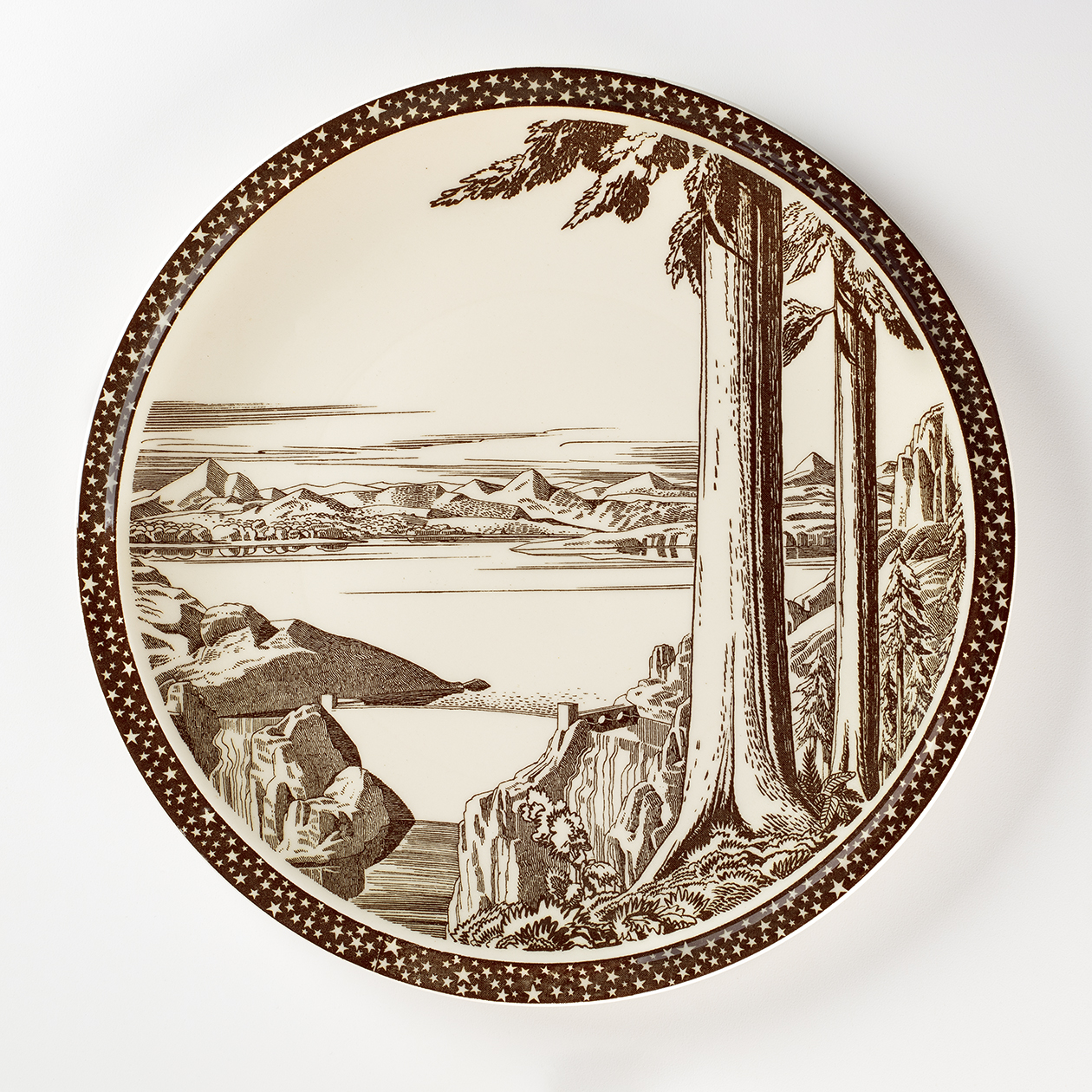
Many artists were gravitating to printmaking, as a way of making their art more accessible to the public, especially middle- class consumers. While the designs for his other two services were based on his book illustrations, those he executed for Our America were created afresh. His stark wood-cuts were adapted to transfers on china, to be printed in three monochrome hues—blue, mahogany, and brown. The service depicts American scenes ranging geographically from the metropolis of Manhattan to the Great Lakes to the Florida everglades to the West Coast. A number of the scenes represent laborers at work, championing Kent’s nationalistic beliefs in the America of the common man, the workers who made this country.
Kent’s reverence for the diversity of the American landscape and for “the working man” shines through the decoration. The star-spangled borders are wholly consistent with the patriotic theme.
— Metropolitan Museum of Art
Hidden in plain sight, illustrations on porcelain and ceramic ware have, throughout history, transformed functional objects into message-bearers for a wide range of political and propagandistic causes, whether exchanged by heads of state or acquired for use or display in domestic settings.
In the late 1930s and early 1940s, in the aftermath of the Great Depression and in response to the threat of fascism in Europe during World War II, illustrator and painter Rockwell Kent chose to democratize his art and promote nationalistic ideals by creating dinnerware designs for Vernon Kilns, a company in California that produced tableware, giftware, and figurines from 1928 to 1958. Kent’s woodcut illustrations for Vernon Kilns’ Our America series appeared on ceramic plates, cups and saucers, bowls, coffee pots, pitchers, sugar bowls, and other service items that were marketed to middle class consumers. Available in three hues including blue, brown, and maroon, sets were priced from $8.80 to $26.90, and as noted in the company’s advertising, featured “more than thirty different drawings representative of scenes and activities in the various regions of the United States.” The country’s natural beauty and the dedication of laborers who made progress possible were prominent image themes that were in keeping with Kent’s nationalistic beliefs. It is unclear whether Kent’s Southern Plantation was intended to characterize the American South by the antebellum period, with slavery portrayed as a benign institution rooted in tradition, or whether the artist desired to express his admiration for laborers, as was common in his work.
— Stephanie Plunkett Norman Rockwell Museum – IMPRINTED: Illustrating Race 6-2022 – 10-2022

Our America: Southern Plantation
Vernon Kilns “Our America”, bread and butter plate with Southern Plantation, designed by Rockwell Kent, plate design by Gale Turnbull, Manfucturer, Vernon Kilns
c. 1940-1943
transfer printed earthenware, glaze
7.5 x 7.5 x 0.75”

Manhattan Vernon Kilns “Our America” Rockwell Kent (Brown)
transfer printed earthenware, glaze
10.5 x 10.5 x 1”

Chicago Red Vernon Kilns “Our America” Rockwell Kent dinner plate
transfer printed earthenware, glaze
9.5 x 9.5 x 1”

Hoover Dam Vernon Kilns “Our America” Rockwell Kent (Brown)
transfer printed earthenware, glaze
14 x 14 x 1”
Collection of Leslie Ferrin/Ferrin Contemporary
MADE IN OCCUPIED JAPAN
“Occupied Japan” (OJ) is a term used for the time period from 1945 (after World War II) through April 25, 1952; it was during this time that the Allies “occupied” Japan.
https://gotheborg.com/qa/oj.shtml
One of the most fascinating lines of objects to come out of Occupied Japan were objects made to capture the interest and pocketbooks of the GI’s stationed there. This is an area that is collected by those who do collect Occupied Japan material, and it features tobacco-related trinkets, because GI’s tended to smoke.
So we find lighters made of tin with erotic images, and little wooden birds made to hold pipes. Ash trays with all kinds of scenes were also popular, and for a few bucks a GI could collect souvenirs to take home. And boy, did they take these things home — in droves.


“Tiny Indians” Made in Occupied Japan
1945-1952
ceramic
varying dimensions
Vintage Mohawk Trail, Mass. Souvenir Hand Painted Made In Post War Japan
1945-1952
ceramic
7.5” radius


Laundry, Black Child Ashtray Made in Occupied Japan
1945-1952
ceramic


Made in Occupied Japan (Black Child, Watermelon, Chamberpot)
1945-1952
cast porcelain, glaze


Made in Japan (Male and Female Native Americans Figurines)
1945-1952
cast porcelain, glaze,
Woman: 4.25 x 2 x 1.25” , Man: 4.25 x 2 x 1.25”
Collection of Leslie Ferrin/Ferrin Contemporary
21ST CENTURY ART & DESIGN


Paul Scott
Paul Scott is a Cumbrian based artist with a diverse practice and an international reputation.Creating individual pieces that blur the boundaries between fine art, craft and design, he is well known for research into printed vitreous surfaces, as well as his characteristic blue and white artworks in glazed ceramic.


Caroline Slotte
The reworking of second hand objects play a pivotal role in Caroline Slotte´s practice. She manipulates found materials, primarily ceramic everyday items, so that they take on new meanings. The tensions between the recognizable and the enigmatic, the ordinary and the unexpected are recurring thematic concerns. More recent explorations reveal an expanded interest in material perception and material recognition, teasing out situations where the initial visual identification fails resulting in an unsettling state of material confusion. Demonstrating an engaged sensitivity towards the associations, memories and narratives inherent in the objects, Slotte´s intricate physical interventions allows us to see things we would otherwise not have seen.
“Many of the objects that I choose to rework carry within them a rich history, a cultural background that I can pull from. In that way, I can count on the objects triggering associations and my role in the process becomes one of pointing to the material and the stories inherent in it.”
–Caroline Slotte


Garth Johnson
Garth Johnson’s works celebrate the history of ceramic objects and their ability to convey status. He often juxtaposes common vessel forms like plastic containers and soap bottles with gold or silver handles taken from fine silver coffee and teapots.


Connor Czora
Connor Czora is an artist, educator, and activist currently based in Washington, DC. Born in Rochester, NY, they received their BFA in Ceramics and Gender Studies from the Maryland Institute College of Art (MICA) in 2019.
Czora’s work explores the relationships between imperial ceramics, cultural taste, and sociopolitical power structures in the United States. Tracing the history of Western decorative arts, their work interrogates how ideologies are embedded and perpetuated within cultural objects.


Sheila Bridges
Named America’s Best Interior Designer by Time magazine and CNN, Sheila Bridges is considered a creative visionary and design tastemaker. Residing and working in Harlem for more than 25 years, Bridges is recognized for her classic yet versatile design aesthetic and critical eye. She is sought after to create thoughtfully inspired and narrative rich interiors because of her profound sensitivity and appreciation of timeless design and quality craftsmanship.


Elizabeth Alexander
On her series, A Mightier Work is Ahead – I have been collecting Confederate commemorative plates since 2016 in response to the rise in white supremacist pride in contemporary culture. I imagine these objects as Trojan horses hanging innocently among family photos. These plates were printed long after the Civil War with romantic illustrations, and created for people to hang in their homes, to pass dangerous values down to future generations aided by collectable marketing.