

ON VIEW

ARTWORK & INSTALLATIONS


Steven Young Lee
Bonghwang (Phoenix)
2026
13 x 19.5 x 15″
porcelain, copper inlay, glaze
Photo courtesy of the artist.
SARYEONG | 2026
In ancient Korean tradition, four mystical animals known as the Saryeong embody auspicious and divine forces that represent cosmic order, harmony, and virtue. The Yong (Dragon) symbolizes cosmic authority and sovereign power; the Bonghwang (Phoenix) represents wisdom, noble harmony, and peaceful rule; the Geobuk (Turtle) embodies longevity and divination; and the Girin (Qilin), often depicted with the torso of a deer, the hooves of a horse, and the tail of an ox, represents humane virtue and morality. Together, these sacred beings express an ideal balance between humanity, nature, and the cosmos.
This body of work depicts the Saryeong on four vessels referencing specific porcelain forms from Korea’s Joseon dynasty. Drawing upon the history and cultural significance of Korean ceramics, the vessels connect traditional forms with contemporary concerns. Presented in states of collapse, they evoke the fragility of established structures and the disruption of social order and harmony. Their damaged forms suggest a world in which stability has been unsettled, creating space for reflection on the values that sustain a society.
Emerging from these fractured vessels, the Saryeong take on a renewed significance. As symbols of wisdom, virtue, endurance, and balance, they are brought forth to restore harmony and peace during times of societal disruption. By bringing together ancient mythology and the material language of Korean porcelain, this work explores the enduring relevance of cultural traditions and the possibility of renewal amid uncertainty.


Steven Young Lee
Yong (Dragon)
2026
porcelain, copper inlay, glaze
Photo courtesy of the artist.


Steven Young Lee
Girin
2026
porcelain, white slip, glaze
Photo courtesy of the artist.


Steven Young Lee
Geobuk (Turtle/Tortoise)
2026
porcelain, cobalt inlay, glaze
Photo courtesy of the artist.


SHATTERED DREAMS AND MOVEMENTS OF CHANGE
Steven Young Lee
Shattered Dreams and Movements of Change
2023
porcelain, cobalt oxide, copper oxide, white slip, glaze, gold powder, resin
18 x 153 x 3”


TIGER / TIGER AND MAGPIES
Steven Young Lee
Tiger
2019
porcelain, cobalt inlay, glaze
12 x 1 24”
Selection of two plates from “Tiger and Magpie”.
Tiger and Magpies
2019
porcelain, cobalt inlay, glaze
150 x 100 x 1”


BLUE, RED, & WHITE CUP PANELS
Steven Young Lee
Cup Panels
2013, 2015
porcelain, copper inlay, glaze, shelving-glass, aluminum

MELTING POINT
2021 | Group Exhibition at Ferrin Contemporary & Heller Gallery | North Adams, MA & New York, NY
Survey of a diverse group of artists whose use of the melting point is central to their practice.
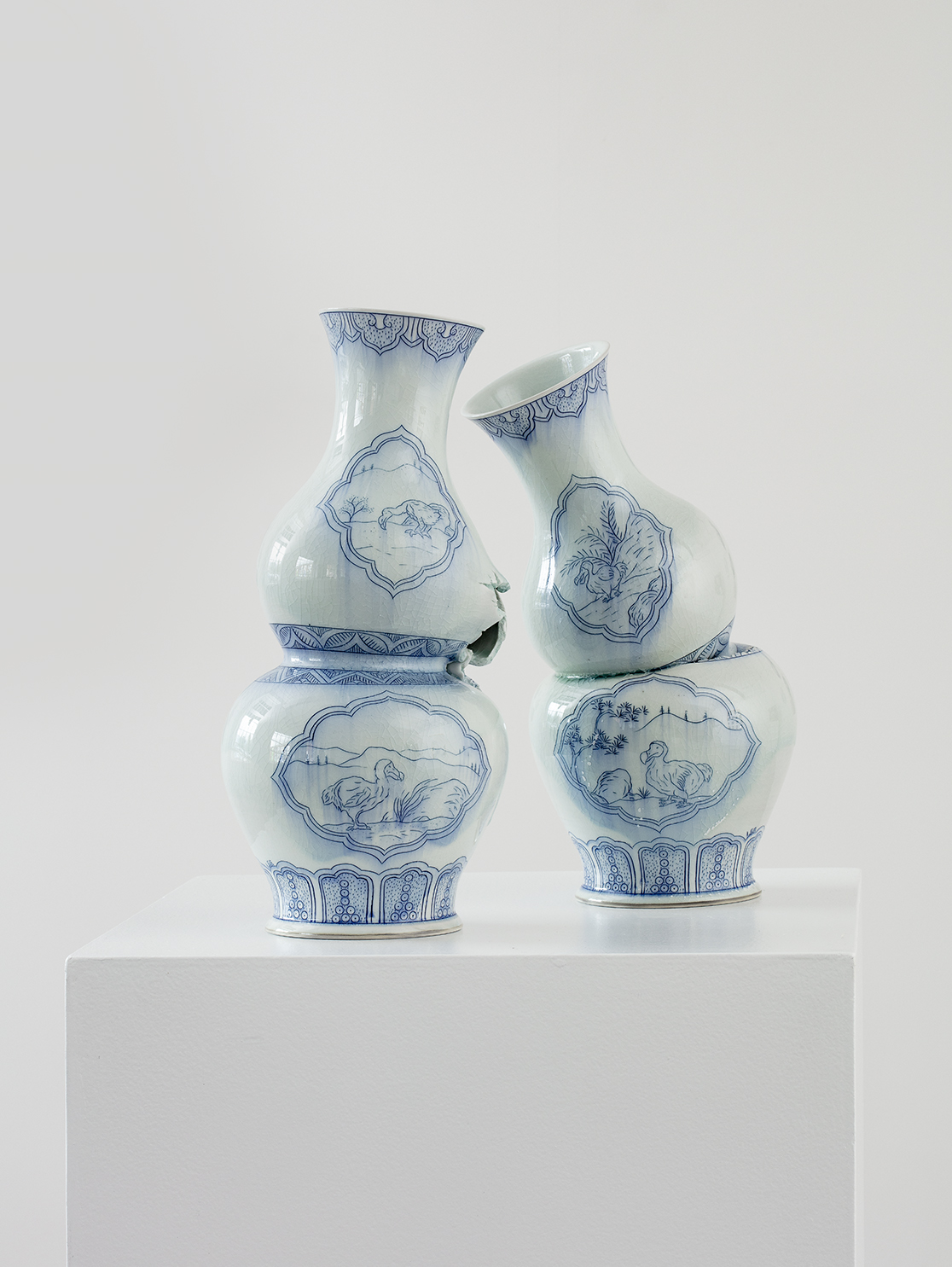
Featuring Gourd Vases with Dodos


ABOUT
American, b. 1975, Chicago, IL
lives and works in Helena, MT
Steven Young Lee is a contemporary artist living in Helena, Montana. He was the Director of the Archie Bray Foundation for the Ceramic Arts for 16 years where he maintained an active studio practice along with orchestrating an organization devoted to excellence in ceramics. In 2004-05, he lectured and taught at numerous universities throughout China as part of a cultural and educational exchange in Jingdezhen, Shanghai and Beijing and spent two months in Seoul, South Korea studying ceramic tradition and history. In 2005-6 he was a visiting professor at Emily Carr Institute of Art and Design in Vancouver, B.C.
Lee has lectured extensively in North America and Asia. In the Fall of 2016 he was one of four artists featured as part of the Renwick Invitational at the Smithsonian Museum in Washington, D.C. In March 2013 he participated on a panel, “Americans in the Porcelain City,” at the Metropolitan Museum of Art in New York. Also in 2013, he was one of several international artists invited to participate in “New Blue and White,” an exhibition at the Museum of Fine Arts in Boston, MA featuring contemporary artists working in the blue-and-white tradition. In 2019, he had a solo exhibition at the Portland Art Museum. In 2021, his work was included in “Crafting America”, a survey of contemporary craft at the Crystal Bridges Museum of American Art and OBJECTS:USA 2020 in partnership with R&Co in New York, NY. In 2023, his work was featured in “Conversing in Clay: Ceramics from the LACMA Collection” at the Los Angeles County Museum of Art. Most recently in 2024, he was a featured artist in the exhibition “Immigration of Ceramics” in Gwangju, South Korea at the Asian Cultural Center.
Lee’s work has been collected by the Smithsonian Museum, the Los Angeles County Museum of Art, Crystal Bridges Museum of Art, the Portland Art Museum, the Newark Museum of Art, the Daum Museum of Contemporary Art, the Everson Museum of Art, the Four Seasons Hotel in Seoul, Korea, and many private and public collections.
Lee earned his BFA and MFA in Ceramics from Alfred University.

ARTIST STATEMENT
As the son of immigrant parents, I am often situated between cultures. Living and working in metropolitan centers such as New York, Chicago, Shanghai, Seoul and Vancouver, as well as the rural communities of Alfred, Jingdezhen and Helena has continually raised questions of identity and assimilation. My experiences range from being an outsider in the country of my heritage to that of being a minority in Montana. Growing up as a second generation Korean American, my identity has felt neither fully Korean or American, and it is through my work where I investigate topics of place and belonging.
I cross-reference historical forms and traditional decorative elements, East and West, to set up unfamiliar, discordant or ironic relationships. Examples include the iconic Moon Jar, a revered vessel from Korea’s rich ceramic history that has become a symbol of Korean culture, identity and pride. Contemporary Asian figures and characters like Bruce Lee and Godzilla were the rare relatable heroes in my youth that were accepted into mainstream culture. I am also fascinated by the power of color symbolism which can be used to convey patriotism or to categorize race dependent on the culture and context they are viewed in. By utilizing these references, it helps me reflect upon my identity as a Korean American and the imperfect relationship regarding dualities of cultural association.
Intentionally deconstructing vessels recalibrates notions of classical perfection and beauty and seeks to critique ideas of failure and expectation, craft skill and the innate value of an object. By making porcelain vessels intended to crack in the firing and morphing decorative practices, I am challenging a deep history of craft protocols and questioning the boundaries and authenticity of identity, ownership and intent.

Steven Young Lee, “Cup Panels”, 2013, porcelain, copper inlay, glaze, shelving-glass, aluminum, 46 x 50 x 4″
ON RED, WHITE, AND BLUE CUP PANELS
This piece comprises three panels, each containing 100 hand-thrown porcelain cups in a ten-by-ten grid. It was originally created for installation at the Jane Hartsook Gallery in New York, NY. The cups are decorated with motifs appropriated from various cultures — Chinese, Korean, French, Dutch, English, etc. In the creation of all 300 cups, the patterns evolved from their original source throughout the process, paralleling the organic development of the visual language of historical pattern as it evolved with ethnic influence.
The title of the piece references three genres of decoration in ceramics — blue and white, red and white, and white on white, while also isolating the representation of color i.e. red, white, and blue to associate with contemporary connotations. In addition, the proportion of the panels correlates to a large color field painting that allows the various motifs to create a single homogenous color representation.
Lee chose to use cups as a vehicle for the decoration because of their status as an archetypal form. And as one of the more intimate ceramic forms, they are relegated to be a small but integral part of the structure of the installation. To reinforce the place of the cup in the whole, the cups are not sold individually, their meaning plays a more expanded role as part of a larger whole.
Janet Koplos reviewed a recent show of Lee’s at Greenwich House Pottery in Ceramics Art and Perception. Read the article here.
FEATURED + RECENT EXHIBITIONS

Steven Young Lee – Saryeong: Four Sacred Creatures
2026 | Lillstreet Art Center | Chicago, IL
September 14 – December 8, 2023


Counterpoint: Three Clay Artists
2023 | Korea Society | New York, NY
September 14 – December 8, 2023


ARE WE THERE YET?
2023 | Ferrin Contemporary | North Adams, MA
July 15 – September 2, 2023
ALL EXHIBITIONS
STEVEN YOUNG LEE: Saryeong: Four Sacred Creatures

October 5 – 29, 2026
Lillstreet Art Center, Chicago, IL
CLAYSCAPES

Everson Museum of Art | Syracuse, NY
April 13 – October 20, 2024
Featuring Cristina Córdova, Paul Scott, & Steven Young Lee
Our America/Whose America? at Ferrin Contemporary, North Adams, MA

Ferrin Contemporary, North Adams, MA
August 6 – October 30, 2022

Conversing in Clay: Ceramics from the LACMA Collection

LACMA, Los Angeles, CA
August 7, 2022 – May 21, 2023

COOL CLAY: Recent Acquisitions of Contemporary Ceramics | Crocker Art Museum

July 21, 2019 – July 21, 2021
TENDING THE FIRES: Recent Acquisitions in Clay | Fuller Craft Museum, Brockton, MA

August 17, 2019 – April 4, 2021


NEWS & MEDIA

The Value of Beauty: A Conversation with Ceramicist Steven Young Lee
Although based in traditional techniques and color schemes, Steven Young Lee’s ceramics are anything but traditional. For example, in one vessel dinosaurs romp through the classic landscapes, while the Trix rabbit is part of the pattern on another. Yet another vessel folds in on itself, as if it was gut-punched just before being put on display, while nearby, it appears that someone has tried to tear a stately urn in half. In his work, Lee is interested in rethinking ideas of beauty and perfection, particularly as they relate to how we think of an object’s value. As he noted during our telephone interview, “One of the questions I get asked the most often is did you mean to do this or did you not mean to do this? I think that that is very revealing.” Lee’s work was recently on view at the Renwick Gallery of the Smithsonian American Art Museum as part of Visions and Revisions: Renwick Invitational 2016. While he admits he was surprised to have an opportunity to show at the museum, he appreciated the opportunity to look at his body of work as a whole. “Usually, I’m making two or three pieces at a time for an exhibition. [For the Renwick show] all that comes together and you get to see how different ideas evolved or how different themes might’ve changed over time.” Here’s more from Lee on how he fell in love with ceramics, what he thinks the most important thing is that he can teach young artists, and how his day job—as an arts administrator—informs his work as an artist.

Steven Young Lee Crafts Perfectly Imperfect Pottery
When artist Steven Young Lee shows one of his peculiar works to those unfamiliar with his “deconstructive” approach to pottery, it sometimes requires an explanation.
“I have to explain to them, ‘No, I meant to do this,’” says Lee, referring to the cracks or wide fissures that mark his vessels. His artwork Peonies Vase looks torn open while the surface of his Vase with Scroll Pattern looks as if a hand has been punched through it. “That’s part of what’s interesting to me: Trying to use the material in a way that most people in ceramics are trying to avoid.”
While ceramics is an artistic field associated with perfection and symmetry, Lee, whose work is on view as part of the 2016 Renwick Invitational, Visions and Revisions, is interested in exploring “clear failures” and the viewer’s response to it.
Wayne Highby on Steven Young Lee—Connections: Renwick Gallery
Taken by the transgressive nature of Steven Young Lee’s porcelain “Vase with Landscape and Dinosaurs,” ceramic artist Wayne Highby appreciates that it challenges and questions the traditional vessel, porcelain history, and also traditional ceramic art.

